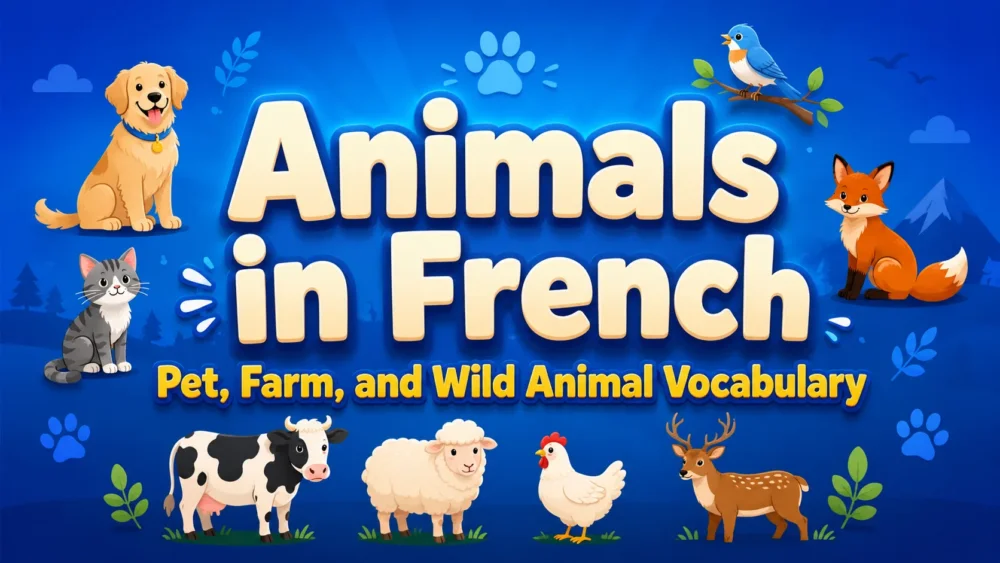
Animals in French are useful words for travel, school, family conversations, children’s learning, nature reading, and everyday speech. French animal vocabulary is easier to remember when it is grouped by pets, farm animals, and wild animals, with each noun learned together with its article: un, une, le, or la.
Most Useful Animal Words In French
- Animal in French is un animal.
- Animals in French is des animaux.
- Pet is usually un animal de compagnie.
- Farm animal can be un animal de ferme.
- Wild animal is un animal sauvage.
- Animal vocabulary is best learned with articles, plural forms, and natural example sentences.
French Articles For Animal Names
Every French animal noun has a grammatical gender. This does not always match the biological sex of the animal. For example, une souris means “a mouse” and is feminine as a noun, even when the mouse is male. A learner should treat the article as part of the word.
| English Idea | French Form | How It Works | Example |
|---|---|---|---|
| A male or masculine noun | un | Used before a masculine singular noun | un chien — a dog |
| A female or feminine noun | une | Used before a feminine singular noun | une vache — a cow |
| The, masculine | le | Used before a masculine singular noun | le cheval — the horse |
| The, feminine | la | Used before a feminine singular noun | la tortue — the turtle |
| Plural animals | des / les | Used for plural animal nouns | des chats — cats; les oiseaux — the birds |
A simple habit helps: learn un chat, not only chat; learn une girafe, not only girafe. The article carries grammar information that later helps with adjectives, pronouns, and sentence flow.
Pets In French
Pets are often the first animal words learners need because they appear in beginner conversations: family, home, likes, dislikes, and descriptions. The French phrase un animal de compagnie means “a pet” or “companion animal.”
| English | French | Plural | Useful Phrase |
|---|---|---|---|
| Dog | un chien | des chiens | J’ai un chien. — I have a dog. |
| Female dog | une chienne | des chiennes | La chienne est calme. — The female dog is calm. |
| Cat | un chat | des chats | Le chat dort. — The cat is sleeping. |
| Female cat | une chatte | des chattes | Elle a une chatte noire. — She has a black female cat. |
| Kitten | un chaton | des chatons | Un chaton joue. — A kitten is playing. |
| Rabbit | un lapin | des lapins | Le lapin mange. — The rabbit is eating. |
| Hamster | un hamster | des hamsters | Mon hamster est petit. — My hamster is small. |
| Guinea pig | un cochon d’Inde | des cochons d’Inde | Le cochon d’Inde est doux. — The guinea pig is gentle. |
| Goldfish | un poisson rouge | des poissons rouges | Nous avons un poisson rouge. — We have a goldfish. |
| Parrot | un perroquet | des perroquets | Le perroquet parle. — The parrot talks. |
| Turtle | une tortue | des tortues | La tortue avance lentement. — The turtle moves slowly. |
| Mouse | une souris | des souris | Une souris est dans la cage. — A mouse is in the cage. |
Pet Sentences For Everyday French
- J’ai un animal de compagnie. — I have a pet.
- Je n’ai pas d’animal. — I do not have an animal.
- Mon chien est très gentil. — My dog is very kind.
- Ma tortue est petite. — My turtle is small.
- Mes chats aiment dormir. — My cats like sleeping.
- Tu as un lapin ? — Do you have a rabbit?
A Note On “My” In French
French uses mon, ma, and mes for “my.” The choice depends on the noun, not the owner. Use mon chien for “my dog,” ma souris for “my mouse,” and mes chats for “my cats.”
Farm Animals In French
Farm animal vocabulary appears in children’s books, food conversations, rural travel, agriculture texts, and animal stories. In French, la ferme means “the farm,” and un animal de ferme means “a farm animal.”
| English | French | Plural | Useful Phrase |
|---|---|---|---|
| Cow | une vache | des vaches | La vache est dans le champ. — The cow is in the field. |
| Bull | un taureau | des taureaux | Le taureau est grand. — The bull is large. |
| Calf | un veau | des veaux | Un veau suit sa mère. — A calf follows its mother. |
| Horse | un cheval | des chevaux | Le cheval court. — The horse runs. |
| Mare | une jument | des juments | La jument est blanche. — The mare is white. |
| Foal | un poulain | des poulains | Le poulain marche. — The foal walks. |
| Pig | un cochon | des cochons | Le cochon mange. — The pig is eating. |
| Sow | une truie | des truies | La truie dort. — The sow sleeps. |
| Sheep | un mouton | des moutons | Le mouton est dans le pré. — The sheep is in the meadow. |
| Ewe | une brebis | des brebis | La brebis protège son agneau. — The ewe protects her lamb. |
| Lamb | un agneau | des agneaux | Un agneau est jeune. — A lamb is young. |
| Goat | une chèvre | des chèvres | La chèvre grimpe. — The goat climbs. |
| Chicken / hen | une poule | des poules | La poule pond un œuf. — The hen lays an egg. |
| Rooster | un coq | des coqs | Le coq chante. — The rooster crows. |
| Chick | un poussin | des poussins | Le poussin est jaune. — The chick is yellow. |
| Duck | un canard | des canards | Le canard nage. — The duck swims. |
| Goose | une oie | des oies | L’oie marche près de l’eau. — The goose walks near the water. |
| Donkey | un âne | des ânes | L’âne porte un sac. — The donkey carries a bag. |
Farm Places And Useful Nouns
- une ferme — a farm
- un champ — a field
- un pré — a meadow
- une étable — a cowshed or stable for cattle
- une grange — a barn
- un poulailler — a chicken coop
- un troupeau — a herd or flock
- un œuf — an egg
These place words make animal vocabulary more natural. Instead of only saying une vache, learners can say une vache dans un champ or un cheval près de la grange. The noun becomes part of a clear scene.
Wild Animals In French
Wild animals are called les animaux sauvages in French. This group includes animals from forests, mountains, deserts, rivers, oceans, grasslands, and zoos. Some words look almost the same as English, such as un lion and un tigre. Others are less transparent, such as un écureuil for “a squirrel.”
Common Wild Mammals
| English | French | Plural | Example Sentence |
|---|---|---|---|
| Lion | un lion | des lions | Le lion vit en Afrique. — The lion lives in Africa. |
| Lioness | une lionne | des lionnes | La lionne chasse. — The lioness hunts. |
| Tiger | un tigre | des tigres | Le tigre est rayé. — The tiger is striped. |
| Bear | un ours | des ours | L’ours est dans la forêt. — The bear is in the forest. |
| Wolf | un loup | des loups | Le loup marche dans la neige. — The wolf walks in the snow. |
| Fox | un renard | des renards | Le renard est rapide. — The fox is fast. |
| Deer | un cerf | des cerfs | Le cerf a des bois. — The deer has antlers. |
| Monkey | un singe | des singes | Le singe grimpe dans l’arbre. — The monkey climbs in the tree. |
| Elephant | un éléphant | des éléphants | L’éléphant a une trompe. — The elephant has a trunk. |
| Giraffe | une girafe | des girafes | La girafe a un long cou. — The giraffe has a long neck. |
| Zebra | un zèbre | des zèbres | Le zèbre a des rayures. — The zebra has stripes. |
| Kangaroo | un kangourou | des kangourous | Le kangourou saute. — The kangaroo jumps. |
| Squirrel | un écureuil | des écureuils | L’écureuil cherche des noix. — The squirrel looks for nuts. |
| Hedgehog | un hérisson | des hérissons | Le hérisson est petit. — The hedgehog is small. |
Birds, Reptiles, Amphibians, And Sea Animals
| English | French | Animal Group | Natural Use |
|---|---|---|---|
| Bird | un oiseau | Bird | Un oiseau chante. — A bird sings. |
| Eagle | un aigle | Bird | L’aigle vole haut. — The eagle flies high. |
| Owl | un hibou | Bird | Le hibou sort la nuit. — The owl comes out at night. |
| Penguin | un pingouin | Bird | Le pingouin nage. — The penguin swims. |
| Snake | un serpent | Reptile | Le serpent glisse. — The snake slithers. |
| Lizard | un lézard | Reptile | Le lézard est au soleil. — The lizard is in the sun. |
| Crocodile | un crocodile | Reptile | Le crocodile est près de l’eau. — The crocodile is near the water. |
| Frog | une grenouille | Amphibian | La grenouille saute. — The frog jumps. |
| Fish | un poisson | Fish | Le poisson nage. — The fish swims. |
| Shark | un requin | Fish | Le requin vit dans la mer. — The shark lives in the sea. |
| Whale | une baleine | Marine mammal | La baleine est immense. — The whale is huge. |
| Dolphin | un dauphin | Marine mammal | Le dauphin nage vite. — The dolphin swims fast. |
| Octopus | une pieuvre | Sea animal | La pieuvre a huit bras. — The octopus has eight arms. |
| Crab | un crabe | Sea animal | Le crabe marche sur le sable. — The crab walks on the sand. |
Animal Babies In French
French often has separate words for baby animals. These words are common in children’s stories, nature writing, and basic animal descriptions. A puppy is not simply un petit chien; the usual word is un chiot.
| Adult Animal | Baby Animal In French | English Meaning | Example |
|---|---|---|---|
| un chien | un chiot | a puppy | Le chiot joue. — The puppy plays. |
| un chat | un chaton | a kitten | Le chaton dort. — The kitten sleeps. |
| une vache | un veau | a calf | Le veau boit du lait. — The calf drinks milk. |
| un cheval | un poulain | a foal | Le poulain court. — The foal runs. |
| un mouton | un agneau | a lamb | L’agneau est dans le pré. — The lamb is in the meadow. |
| une poule | un poussin | a chick | Le poussin suit la poule. — The chick follows the hen. |
| un canard | un caneton | a duckling | Le caneton nage. — The duckling swims. |
| un lion | un lionceau | a lion cub | Le lionceau reste près de sa mère. — The lion cub stays near its mother. |
| un ours | un ourson | a bear cub | L’ourson est petit. — The bear cub is small. |
Animal Sounds In French
Animal sounds are not copied the same way in every language. French has its own sound words, verbs, and classroom phrases. These are useful for songs, children’s books, and playful speech.
| Animal | French Animal | French Sound | Verb Often Used |
|---|---|---|---|
| Dog | le chien | ouaf ouaf | aboyer — to bark |
| Cat | le chat | miaou | miauler — to meow |
| Cow | la vache | meuh | meugler — to moo |
| Sheep | le mouton | bêê | bêler — to bleat |
| Rooster | le coq | cocorico | chanter — to crow |
| Duck | le canard | coin-coin | cancaner — to quack |
| Frog | la grenouille | croa croa | coasser — to croak |
| Bird | l’oiseau | cui-cui | chanter — to sing |
Pronunciation Detail
Several French animal words begin with a vowel sound, so the article shortens: l’oiseau, l’ours, l’éléphant, and l’écureuil. This contraction makes speech smoother. In plural form, the final s is usually silent: des chats sounds close to “day sha.”
Masculine And Feminine Animal Pairs
Some French animal names have separate masculine and feminine forms. This matters when the sex of the animal is part of the meaning, as with un coq and une poule. In many everyday situations, the general animal name is enough.
| Male | Female | English Pair | Note |
|---|---|---|---|
| un chien | une chienne | dog / female dog | Un chien can also mean dog in a general sense. |
| un chat | une chatte | cat / female cat | Un chat is widely used as the general word. |
| un coq | une poule | rooster / hen | Common farm vocabulary pair. |
| un taureau | une vache | bull / cow | Une vache is also the common word children learn first. |
| un cheval | une jument | horse / mare | Un cheval is the general word for horse. |
| un mouton | une brebis | ram or sheep / ewe | Un bélier specifically means ram. |
| un lion | une lionne | lion / lioness | Common in wildlife descriptions. |
| un loup | une louve | wolf / female wolf | Useful in stories and nature texts. |
French Animal Plurals
Most French animal nouns form the plural by adding -s, but some high-frequency words change in a more visible way. The plural ending is often silent in speech, so spelling deserves attention.
| Singular | Plural | English | Pattern |
|---|---|---|---|
| un chat | des chats | cats | Add -s |
| un chien | des chiens | dogs | Add -s |
| une tortue | des tortues | turtles | Add -s |
| un cheval | des chevaux | horses | -al often changes to -aux |
| un animal | des animaux | animals | -al changes to -aux |
| un oiseau | des oiseaux | birds | Words ending in -eau take -x |
| un veau | des veaux | calves | Words ending in -eau take -x |
| une souris | des souris | mice | Already ends in -s |
| un ours | des ours | bears | Already ends in -s |
Adjectives For Describing Animals In French
Animal vocabulary becomes more useful when paired with simple French adjectives. In French, adjectives usually agree with the noun. This means un petit chien but une petite souris.
Size And Shape
- petit / petite — small
- grand / grande — big, tall
- gros / grosse — large, stout
- long / longue — long
- court / courte — short
Color And Pattern
- blanc / blanche — white
- noir / noire — black
- brun / brune — brown
- gris / grise — gray
- rayé / rayée — striped
- tacheté / tachetée — spotted
Behavior
- calme — calm
- rapide — fast
- lent / lente — slow
- gentil / gentille — kind, gentle
- sauvage — wild
- domestique — domestic
Body Parts
- une patte — a leg or paw
- une queue — a tail
- une aile — a wing
- un bec — a beak
- une griffe — a claw
- des poils — fur or hairs
- des plumes — feathers
- des écailles — scales
Useful French Sentences About Animals
Short model sentences help learners move from isolated nouns to real communication. These patterns work with many French animal names.
| French Sentence | English Meaning | Pattern To Reuse |
|---|---|---|
| J’aime les animaux. | I like animals. | J’aime les… |
| Je préfère les chiens. | I prefer dogs. | Je préfère les… |
| Mon animal préféré est le tigre. | My favorite animal is the tiger. | Mon animal préféré est… |
| Le chat est noir. | The cat is black. | Le / la + animal + est… |
| La girafe a un long cou. | The giraffe has a long neck. | Animal + a + body part |
| Les oiseaux volent. | Birds fly. | Les + plural animal + verb |
| Le poisson vit dans l’eau. | The fish lives in water. | Animal + vit dans… |
| Il y a un renard dans la forêt. | There is a fox in the forest. | Il y a + animal + place |
| Nous voyons des canards au parc. | We see ducks at the park. | Nous voyons des… |
| Elle dessine une baleine. | She is drawing a whale. | Subject + verb + animal |
French Verbs Used With Animals
A small set of verbs covers many animal sentences. These verbs are useful for classroom writing, travel notes, and beginner speaking practice.
| French Verb | English Meaning | Animal Example | English Translation |
|---|---|---|---|
| avoir | to have | J’ai un chien. | I have a dog. |
| aimer | to like, to love | J’aime les chats. | I like cats. |
| voir | to see | Je vois un oiseau. | I see a bird. |
| vivre | to live | Le dauphin vit dans la mer. | The dolphin lives in the sea. |
| manger | to eat | La vache mange de l’herbe. | The cow eats grass. |
| courir | to run | Le cheval court. | The horse runs. |
| voler | to fly | L’oiseau vole. | The bird flies. |
| nager | to swim | Le poisson nage. | The fish swims. |
| grimper | to climb | Le singe grimpe. | The monkey climbs. |
| dormir | to sleep | Le chat dort. | The cat sleeps. |
Animal Habitats In French
Habitat words make French animal vocabulary more precise. They also help learners describe where animals live, move, swim, fly, or rest.
| Habitat In English | French | Example With Animal | Meaning |
|---|---|---|---|
| Forest | la forêt | Le renard vit dans la forêt. | The fox lives in the forest. |
| Sea | la mer | La baleine vit dans la mer. | The whale lives in the sea. |
| River | la rivière | Le canard nage dans la rivière. | The duck swims in the river. |
| Mountain | la montagne | La chèvre grimpe dans la montagne. | The goat climbs in the mountain. |
| Desert | le désert | Le chameau marche dans le désert. | The camel walks in the desert. |
| Meadow | le pré | Le mouton est dans le pré. | The sheep is in the meadow. |
| Field | le champ | La vache est dans le champ. | The cow is in the field. |
| Water | l’eau | Le poisson vit dans l’eau. | The fish lives in water. |
| Tree | l’arbre | L’écureuil est dans l’arbre. | The squirrel is in the tree. |
| Zoo | le zoo | Nous voyons une girafe au zoo. | We see a giraffe at the zoo. |
Similar Animal Words In French And English
Some animal names are easy to recognize because French and English share many Latin-based words. These familiar forms can speed up learning, but pronunciation and articles still matter.
| English | French | What To Notice |
|---|---|---|
| Animal | un animal | The plural changes: des animaux. |
| Lion | un lion | Spelling is the same; pronunciation differs. |
| Tiger | un tigre | Close to English, but the final sound is softer. |
| Elephant | un éléphant | Accent marks change the written form. |
| Giraffe | une girafe | Same animal, different spelling and article. |
| Zebra | un zèbre | The accent marks the vowel sound. |
| Crocodile | un crocodile | Same spelling, French pronunciation. |
| Serpent | un serpent | In French, this means “snake.” |
Common Learner Mistakes With French Animal Vocabulary
- Forgetting the article: learn une grenouille, not only grenouille.
- Using English plural logic: un cheval becomes des chevaux, not des chevals.
- Mixing general and specific names: un cheval is a horse, while une jument is a mare.
- Translating pet too directly: the natural phrase is un animal de compagnie.
- Ignoring contractions: say and write l’oiseau, not le oiseau.
- Expecting sound words to match English: a French rooster says cocorico, not “cock-a-doodle-doo.”
French Animal Vocabulary By Learning Level
A learner does not need every animal word at once. A steady order works better: start with common pets, then farm animals, then wild animals, then baby animals, habitats, and descriptive sentences.
| Level | Best Words To Learn | Useful Goal | Example Output |
|---|---|---|---|
| Beginner | chien, chat, oiseau, poisson, lapin | Name common pets | J’ai un chat. |
| Beginner Plus | vache, cheval, mouton, poule, canard | Talk about farm animals | La vache mange. |
| Lower Intermediate | lion, tigre, ours, loup, renard | Describe wild animals | Le loup vit dans la forêt. |
| Intermediate | chiot, chaton, veau, poulain, agneau | Use baby animal words | Le chiot joue. |
| Intermediate Plus | plumes, écailles, griffes, queue, bec | Describe animal bodies | L’oiseau a des plumes. |
| Practical Use | forêt, mer, champ, rivière, zoo | Say where animals live | Le poisson vit dans l’eau. |
Practice Set: Translate The Animal Word
Use these short prompts for self-checking. Read the English word, say the French form with its article, then check the answer.
How do you say “a dog” in French?
un chien
How do you say “a cat” in French?
un chat
How do you say “a cow” in French?
une vache
How do you say “a horse” in French?
un cheval
How do you say “a bird” in French?
un oiseau
How do you say “a fish” in French?
un poisson
How do you say “wild animals” in French?
les animaux sauvages
Sources
The following reference pages are useful for checking French spelling, grammar, animal terms, and standard dictionary usage.
- Dictionnaire de l’Académie française — French dictionary reference
- CNRTL — Definition of “animal” in French
- Larousse — “animal” dictionary entry
- Collins English-French Dictionary — animal vocabulary reference
- WordReference English-French Dictionary — animal translation entries
French Animal Vocabulary FAQ
What is the French word for animals?
The French word for animals is des animaux. The singular form is un animal. The final x in animaux is usually silent in normal speech.
How do you say pets in French?
The usual French phrase for pets is les animaux de compagnie. A pet is un animal de compagnie. Common pet words include un chien, un chat, un lapin, and un poisson rouge.
How do you say farm animals in French?
Farm animals in French can be translated as les animaux de ferme. Common examples include une vache, un cheval, un mouton, une chèvre, une poule, and un canard.
How do you say wild animals in French?
Wild animals in French is les animaux sauvages. Examples include un lion, un tigre, un ours, un loup, un renard, une girafe, and un éléphant.
Why do French animal words need articles?
French nouns have grammatical gender. The article tells the learner whether the noun is usually masculine or feminine. For example, un chien is masculine, while une tortue is feminine.
What is the plural of animal in French?
The plural of un animal is des animaux. This is a common French plural pattern where some nouns ending in -al change to -aux.