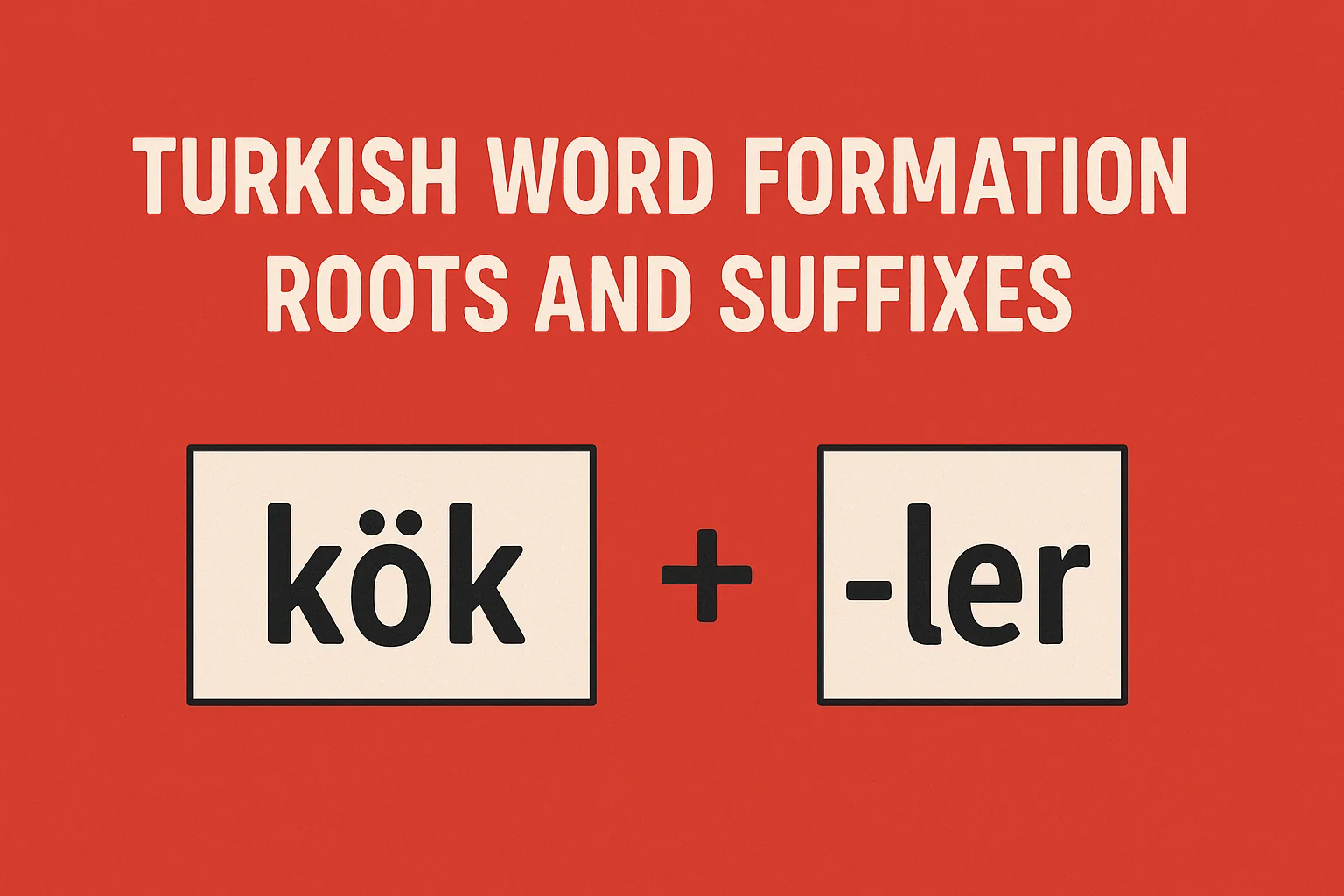
Understanding Turkish word formation means seeing how a simple root grows step by step with rich suffixes. This guide focuses on clear, practical facts about how roots and suffixes work together in modern Turkish.
- What a root is in Turkish.
- Main suffix types and what they do.
- How suffixes line up in a typical Turkish word.
- Patterns and tips to read and build new words with confidence.
Core Features of Turkish Word Formation
- Agglutinative structure: Turkish is an agglutinative language. Words are built by adding several suffixes to a single root, each carrying one clear meaning.
- Transparent components: In most cases the root stays visible (for example, ev “house” in ev-ler-im-de – “in my houses”).
- Strict order of suffixes: Derivational suffixes usually come closer to the root; inflectional suffixes (plural, case, person, tense) stand further to the right.
- Vowel harmony: Many suffixes change their vowel to match the last vowel of the root, which gives Turkish its very regular sound pattern.
Very Short Formula for many Turkish words:
ROOT + (derivational suffixes) + plural + possessive + case + (clitic)
Example: ev-ler-im-de-ki = in my houses that …
Types of Roots in Turkish
Lexical roots carry the main meaning and accept most suffixes.
- Noun roots: ev (house), okul (school), kitap (book).
- Verb roots: gel (come), git (go), yaz (write).
- Adjective roots: güzel (beautiful), yeni (new).
Borrowed roots often come from Arabic, Persian, French, English and keep the same suffix system.
- telefon + -cu → telefoncu (phone seller / repairer).
- modern + -leş- → modernleş-mek (to become modern).
- program + -cı → programcı (programmer).
For word formation, the key is to spot the simplest root first, before you analyse the suffixes. This looks simple at first sigth, but practice makes it very natural.
Suffix Classes: Derivational and Inflectional
- Derivational suffixes (yapım ekleri) create a new word with a new dictionary meaning.
- Noun → noun: öğrenci (student) + -lik → öğrenci-lik (student life, “being a student”).
- Noun → verb: taş (stone) + -ı- + -mak → taş-ı-mak (to carry).
- Verb → noun: oku- (read) + -ma → oku-ma (reading).
- Verb → verb: yaz- (write) + -dır → yaz-dır-mak (to have something written).
- Inflectional suffixes (çekim ekleri) show how the word behaves in the sentence without changing the basic dictionary meaning.
- Plural: -lar / -ler → ev-ler (houses).
- Possession: -im / -ın / -ı / -ımız etc. → ev-im (my house), ev-in (your house).
- Case: -e, -de, -den, -i etc. → ev-e (to the house), ev-de (in the house).
- Verb tense, aspect, mood: -iyor, -di, -ecek, -miş etc. → gel-iyor-um (I am coming).
- Person: -m, -n, -k, -nız, -lar etc. → marks who does the action.
Key Suffix Types Overview
The table below groups some frequent Turkish suffixes by function. Forms change with vowel harmony, but the core idea stays stable.
| Suffix Type | Main Function | Typical Forms | Example Analysis |
|---|---|---|---|
| Plural | Marks “more than one”. | -lar / -ler | ev-ler = ev (house) + plural → houses |
| Possessive (1sg) | Shows personal possession. | -ım / -im / -um / -üm | ev-im = my house |
| Case (location) | Links the noun to the verb. | -e, -de, -den, -i | ev-ler-im-de = in my houses |
| Noun → noun (deriv.) | Makes related concepts. | -ci / -cı / -cu / -cü; -lik / -lık / -luk / -lük | kitap-çı (bookseller), öğrenci-lik (student-hood) |
| Verb → noun (deriv.) | Makes action or result nouns. | -ma / -me; -ış / -iş / -uş / -üş | oku-ma (reading), konuş-ma (speaking) |
| Verb tense + person | Marks time and subject. | -iyor, -di, -ecek + person suffix | gel-iyor-um = come + prog. + 1sg → I am coming |
Watch: Turkish Suffixes in Practice
A short, practical video can help you hear roots and suffixes in real speech. The clip below focuses on how suffixes shape meaning in everyday Turkish.
Vowel Harmony and Consonant Changes in Suffixes
- Two-way vowel harmony: Some suffixes have a / e alternation.
- -lar / -ler → ev-ler (houses), gün-ler (days).
- The vowel chooses back or front depending on the last vowel of the root.
- Four-way vowel harmony: Many suffixes appear as -ı / -i / -u / -ü.
- Possessive: kapı-m (my door), göz-üm (my eye), yol-um (my road).
- Accusative: kitap-ı (the book as object), göl-ü (the lake as object).
- Consonant voicing: In many words, final p, t, k, ç can change to b, d, ğ, c when a vowel-starting suffix is added.
- kitap → kitab-ı (the book – object).
- ağaç → ağac-ı (the tree – object).
- renk → reng-i (its color).
For learners, noticing vowel harmony and these small consonant shifts turns many long words into predictable patterns rather than something mysterious.
How Roots and Suffixes Line Up in a Word
Below is a step-by-step breakdown of a typical noun phrase. Each new suffix adds one clear idea.
- ev – root, “house”.
- ev-ler – plural: “houses”.
- ev-ler-im – 1st person singular possessive: “my houses”.
- ev-ler-im-de – locative: “in my houses”.
- ev-ler-im-de-ki – relative suffix -ki: “those which are in my houses”.
Even when a word looks long, you can scan it from left to right: find the root, then read each suffix as a small step in meaning.
Quick Reading Strategy
- Locate the root (often the leftmost part).
- Check plural and possessive endings (-ler, -im, -iniz).
- Look for case endings (-e, -de, -den, -i).
- Note any final extra marker like -ki or question particle mi.
Common Derivational Patterns
- Profession and agent nouns (who does something)
- Root + -ci / -cı / -cu / -cü
- öğret-men (teacher) + -lik → öğretmen-lik (teaching, profession).
- balık (fish) + -çı → balık-çı (fisher / fish seller).
- Quality and property nouns
- Adjective + -lık / -lik / -luk / -lük.
- genç (young) → genç-lik (youth).
- yalnız (alone) → yalnız-lık (loneliness).
- Adjectives from nouns
- Noun + -lı / -li / -lu / -lü = “having, with”.
- tuz (salt) → tuz-lu (salty).
- ses (sound) → ses-li (voiced / with sound).
- Negative adjectives
- Noun + -sız / -siz / -suz / -süz = “without”.
- umut (hope) → umut-suz (hopeless).
- ev (home) → ev-siz (without a home).
- Change of state
- Noun / adjective + -laş / -leş = “become X”.
- temiz (clean) → temiz-len-mek (to become clean / be cleaned).
By learning a small set of high-frequency derivational suffixes, you can expand your vocabulary quickly, because one root often gives many related words.
Verb Suffix Chains: Tense, Aspect, Mood and Person
Turkish verbs can carry several suffix layers. A typical chain includes:
- Verb root (meaning).
- Voice / valency (-dir causative, -il passive, -in reflexive, etc.).
- Tense / aspect / mood (-iyor, -di, -ecek, -miş, -se etc.).
- Person and number (-m, -n, -k, -nız, -lar etc.).
- Sometimes an extra clitic like the question particle mi.
Example with several suffixes in a row:
- yaz-dır-a-ma-dı-k-lar-ı-mız-dan
- yaz – write (root).
- -dır – causative: “make someone write”.
- -a-ma – ability + negation: “not be able to”.
- -dı – past tense.
- -k – 1st person plural (we).
- -lar – plural marker on object / relative element.
- -ı – object marker.
- -mız – our.
- -dan – from.
Even if you do not use such long forms in daily conversation, seeing each suffix as one simple step keeps the system very manageable.
Practical Strategies for Learners
- Collect roots, not only whole words
- When you meet a new word, write down the root form separately.
- List a few common derivations from the same root (noun, verb, adjective).
- Group suffixes by function
- Make a small chart for plural, possessive, case, and the most common tense endings.
- Color-code them (for example, one colour for noun suffixes, another for verb suffixes) to see patterns faster.
- Practice decoding long words
- Take one word from news or literature and split it: root + every suffix.
- Check each piece in a reliable grammar source or dictionary.
- Listen for suffixes in speech
- When you hear Turkish, try to catch endings like -yor, -di, -ler, -de, -den.
- Connect the sound of each ending with its meaning, not only with a written rule.
- Use digital tools wisely
- Online morphological analyzers and suffix dictionaries can show you complete breakdowns of complex words.
- Compare their analysis with your own to strengthen your understanding of roots and suffix chains.
Mini Practice Checklist
- Can you quickly find the root in a long word?
- Can you name the main suffixes attached to it?
- Can you explain what each suffix adds to the meaning?
References
- “Turkish Grammar – Morphology” – overview of Turkish word structure and major suffix classes.
- Middle East Technical University – Overview of Turkish Word Inflection – examples of complex inflection chains from noun roots.
- Wiktionary – Appendix: Turkish Suffixes – broad list of derivational and inflectional suffixes with examples.
- The Turkish Suffix Dictionary – searchable reference for many productive suffixes.
- Ankara University – Open Course Material on Turkish Person Suffixes – detailed description of person endings and their use.