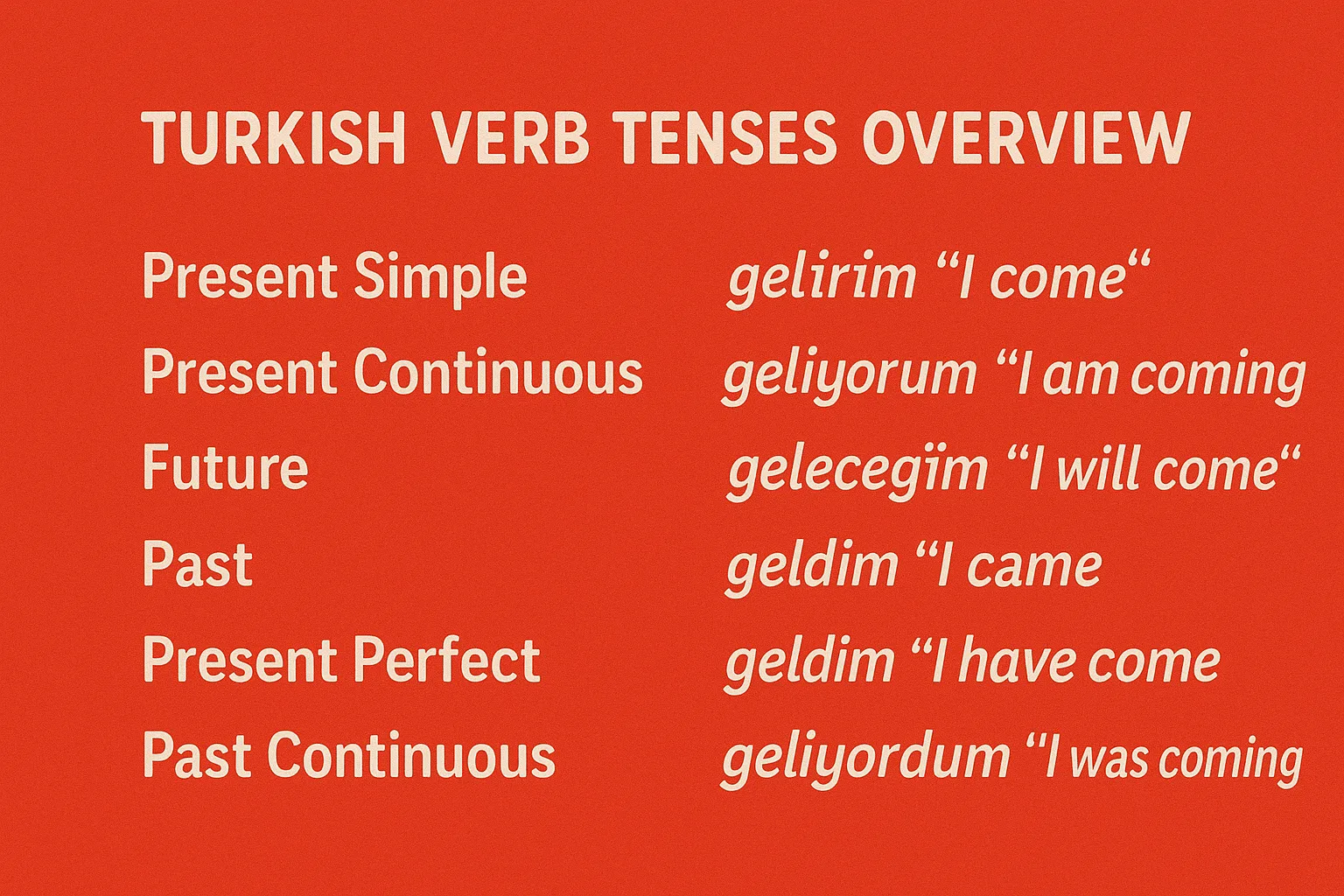
Key Features Of Turkish Verb Tenses
Turkish verb tenses are built almost entirely with suffixes. A single verb form can carry tense, aspect, mood, negation, question and person at once, which makes Turkish look dense but actually very systematic when you understand the patterns.
- Agglutinative structure: verb stem + tense suffix + personal ending (and sometimes auxiliary forms like idi, imiş, ise).
- Few irregular verbs: most Turkish tenses follow regular patterns, so once you learn one verb, you can apply the same pattern to others.
- Rich time and viewpoint system: simple tenses (like present continuous or simple past) combine with auxiliary elements to form many compound tenses.
- Evidentiality: some past forms in Turkish (for example the -miş past) also show how the speaker knows about the event, not only when it happened.
- Consistent vowel harmony: all tense suffixes adapt to the vowels of the stem, which keeps Turkish verb tenses sounding natural and smooth.
Form Side
- Verb stem (for example gel- “to come”).
- Tense / aspect suffix (for example -iyor, -di, -ecek).
- Personal ending (for example -um, -sin, -iz).
- Optional auxiliary elements such as idi, imiş, ise for compound tenses.
Meaning Side
- Time: past, present, future.
- Aspect: ongoing, habitual, completed, or repeated actions.
- Modality: necessity, condition, wish, imperative.
- Source of information: directly witnessed or reported / inferred events.
Core Simple Tenses In Turkish
Many descriptions of Turkish verb tenses talk about several simple tenses (built with one main tense suffix) and many compound tenses (formed with an extra auxiliary). The table below gives a compact overview using the verb gelmek “to come”.
| English Name | Turkish Name | Typical Suffix | Example (1st sg.) | Basic Meaning |
|---|---|---|---|---|
| Present Continuous | Şimdiki zaman | -(I)yor | geliyorum | I am coming (right now / these days) |
| Simple Present / Aorist | Geniş zaman | -r, -(A)r | gelirim | I (usually) come, I will come (in some contexts) |
| Simple Past (Direct) | Görülen geçmiş zaman | -di (harmonic forms: -dı, -du, -dü, -ti, -tı, -tu, -tü) | geldim | I came (I saw / experienced it myself) |
| Reported / Inferential Past | Öğrenilen geçmiş zaman | -miş (harmonic forms: -mış, -miş, -muş, -müş) | gelmişim | Apparently I came, it seems I have come |
| Future | Gelecek zaman | -ecek / -acak | geleceğim | I will come / I am going to come |
This table shows how verb stems, tense suffixes and personal endings work together. Once this structure is clear, the apparently complex Turkish tense system becomes much easier to handle, even if the grammer first looks heavy.
Present Continuous Tense (-yor)
- Form: verb stem + -iyor / -ıyor / -uyor / -üyor + personal ending.
Example: gel-iyor-um “I am coming”. - Use: actions happening right now or around the current time; also for ongoing projects and temporary situations.
- Spelling note: with verbs ending in -a or -e, the vowel often narrows: oynayor → oynuyor, başlayor → başlıyor; this is a regular pattern.
- Very common in everyday speech, so mastering -yor early gives a big boost to fluent conversation.
Simple Present / Aorist Tense (-r)
- Form: for most verbs, verb stem + -r or -(A)r + personal ending.
Example: gel-ir-im “I (usually) come”. - Main meanings:
- Habits: Her sabah erken kalkarım – “I get up early every morning.”
- General truths: Su yüz derecede kaynar – “Water boils at one hundred degrees.”
- Planned future in some contexts: Yarın gelirim – “I’ll come tomorrow.”
- Frequency adverbs like her gün, genellikle, çoğu zaman often appear with this tense, signaling its habitual meaning.
Simple Past Tense (-di)
- Form: verb stem + -di / -dı / -du / -dü / -ti / -tı / -tu / -tü + personal ending.
Example: gel-di-m “I came”. - Meaning: completed past actions that the speaker presents as directly witnessed, certain or definite.
- Typical uses:
- telling a story about yesterday or last week, step by step,
- reporting something clearly finished,
- giving personal experiences.
Reported / Inferential Past Tense (-miş)
- Form: verb stem + -miş / -mış / -muş / -müş + personal ending.
Example: gel-miş-im “Apparently I came / It seems I have come”. - Meaning: past events learned indirectly (hearsay) or inferred from evidence; also often used for narrative or surprise.
- Pragmatic effect: this tense can sound softer, less direct, or more emotional, depending on context.
Future Tense (-ecek / -acak)
- Form: verb stem + -ecek / -acak + personal ending.
Example: gel-ecek-im → geleceğim “I will come”. - Use: future plans, predictions, promises and expectations.
- Nuance: depending on intonation and context, this tense may sound like a strong promise, a neutral plan, or even a gentle warning.
Compound Tenses With “idi”, “imiş” And “ise”
Beyond the simple suffixes, Turkish compound tenses combine a simple tense with the auxiliary forms idi (was), imiş (is said to be / apparently was) or ise (if / as for). This creates fine distinctions such as was doing, had done, was going to do, and so on.
- Present continuous in the past: geliyordum – “I was coming”.
Pattern: stem + -iyor + past personal ending. - Past perfect type: gelmişti – “(he/she) had come”.
Pattern: stem + -miş + idi → -mişti. - Reported future in the past: gelecekmiş – “(they say) he/she will come / was going to come”.
- Conditional combinations: patterns like gelseydi (“if he had come”) show both conditional mood and past reference in one verb chain.
These compound verb tenses may look long, but each extra element adds a clear, logical piece of meaning. Learners who read them slowly from left to right can usually decode them step by step.
Negation And Questions In Turkish Verb Tenses
In Turkish verb tenses, negation and questions are also expressed with suffixes and particles, not with separate helping verbs like “do” or “will”. Understanding where to place these elements is essential for accurate sentences.
- Negation suffix: the basic negative marker is -me / -ma, which usually appears before the tense suffix.
Examples:- gel-me-yor-um – “I am not coming”.
- gel-me-di – “he/she did not come”.
- gel-me-yecek-siniz – “you (pl.) will not come”.
- Question particle: yes/no questions use the separate particle mı / mi / mu / mü, which follows vowel harmony.
Examples:- Geliyor musun? – “Are you coming?”
- Gelmediler mi? – “Did they not come?”
- Word order: the question particle normally follows the tense-person complex and stands as a separate word in writing, even though it sounds closely attached in speech.
How Many Turkish Verb Tenses Are There?
Different grammars describe Turkish verb tenses in slightly different ways. Some focus only on the main simple tenses, while others also count many compound forms created with auxiliaries like idi, imiş and ise.
- A common description mentions about nine simple tenses (including tense-like moods such as necessity and conditional).
- When the compound forms are added, some sources talk about twenty or more compound tenses.
- In practical learning, most students start with a core group:
- present continuous (şimdiki zaman)
- simple present / aorist (geniş zaman)
- simple past (-di geçmiş zaman)
- reported past (-miş geçmiş zaman)
- future (gelecek zaman)
- After this, necessity (-meli), conditional (-se) and other modal forms can be added as an extended layer of the tense–mood system.
Practical Study Tips For Turkish Verb Tenses
- Think in layers, not in separate tables: first identify the verb stem, then the tense suffix, then the personal ending, and finally any auxiliary element. This layered view makes long forms much clearer.
- Use one model verb for each tense: for example, conjugate gelmek “to come” or okumak “to read” in all simple tenses, and keep that table nearby while speaking or writing.
- Connect tense with time expressions: pair every tense with typical adverbs and phrases:
- şimdi, şu anda → present continuous,
- her gün, genellikle → simple present,
- dün, geçen hafta → simple past,
- yarın, birazdan → future.
- Practice contrasting close forms: write pairs like geldi vs. gelmiş, geliyorum vs. gelirim, and explain the difference to yourself in simple English. This sharpens your sense of nuance.
- Listen for evidentiality: pay attention when speakers use -miş; it often signals surprise, a story told later, or information learned indirectly.
- Accept long forms as normal: forms like gelemezmişsiniz may look intimidating, but each part is just one more logical step added to the chain.
References
For deeper study of Turkish verb tenses, the following high-quality resources from official and academic institutions can be consulted:
- Türk Dil Kurumu (TDK) – Fiil Çekimi ile İlgili Yazılışlar (spelling and usage notes for tense suffixes): https://tdk.gov.tr/icerik/yazim-kurallari/fiil-cekimi-ile-ilgili-yazilislar/
- Türk Dil Kurumu (TDK) – Ünlü Daralması (vowel narrowing in forms like -yor): https://tdk.gov.tr/icerik/yazim-kurallari/unlu-daralmasi/
- Türk Dil Kurumu – Karşılaştırmalı Türk Lehçeleri Fiil Çekim Kılavuzu (comparative verb conjugation guide for Turkish varieties): https://tdk.gov.tr/karsilastirmali-turk-lehceleri-fiil-cekim-kilavuzu/
- DergiPark / Dicle Üniversitesi – Candemir Doğan, “Tenses in Turkish and Teaching to Arabic Students” (article on teaching Turkish tense system as a foreign language): https://dergipark.org.tr/tr/download/article-file/2226827
- Ankara Üniversitesi – DTCF Journal – Article on aspect and tense in Turkish and other languages (detailed discussion of zaman and görünüş): https://dspace.ankara.edu.tr/bitstreams/412b15c1-bff8-45fa-8b12-54621c76a0df/download
- Atatürk University & other Turkish universities – various open course and grammar materials on Turkish tenses and verb conjugation, accessible via institutional websites and language teaching portals.