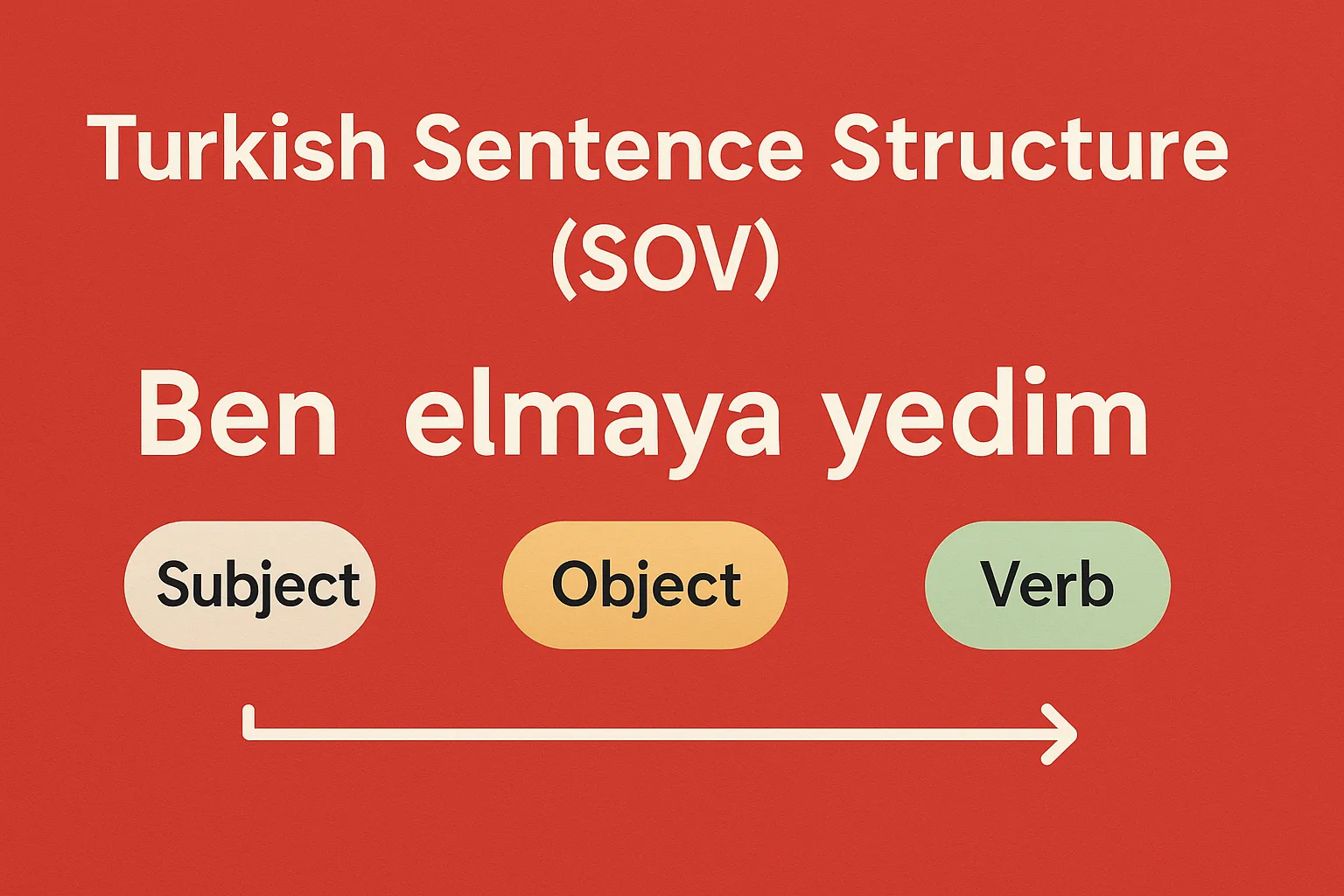
Turkish sentence structure is built around a clear Subject–Object–Verb (SOV) pattern. When learners see that the verb almost always comes at the end, Turkish suddenly feels more predictable, even if the language looks very different from English at first sigth.
Key Elements Of A Turkish Sentence
- Subject (özne): the person or thing that does the action. Example: Ben – “I”, Ali, Öğrenciler (“the students”).
- Object (nesne): what the action affects; often marked with case endings. Example: kitabı (“the book”), elmayı (“the apple”).
- Verb (yüklem): the core of the sentence, usually final, carrying tense and person. Example: okuyor (“is reading”), yedi (“ate”), gideceğim (“I will go”).
In a basic Turkish clause, these three elements form a simple but powerful frame: Subject – Object – Verb. Most other parts of the sentence are attached around this frame.
Basic SOV Pattern With Simple Examples
- Ben kitabı okuyorum. Ben (Subject) – kitabı (Object) – okuyorum (Verb) → “I am reading the book.”
- Ali kahveyi içti. Ali (Subject) – kahveyi (Object) – içti (Verb) → “Ali drank the coffee.”
- Öğrenciler soruyu anladılar. Öğrenciler (Subject) – soruyu (Object) – anladılar (Verb) → “The students understood the question.”
English Pattern (SVO)
- Subject – Verb – Object
- I read the book.
- Ali drinks coffee.
Turkish Pattern (SOV)
- Subject – Object – Verb
- Ben kitabı okuyorum.
- Ali kahveyi içiyor.
Watch SOV Word Order In Action
Standard Sentence Frame In Turkish
Many grammars describe a more detailed neutral order. A frequent pattern is:
- Subject
- Time
- Place
- Indirect object (to/for whom)
- Direct object
- Verb
One natural example is: O dün akşam evde bana kitabı verdi. – “He gave me the book at home last night.” Each word fills a clear slot in the frame.
| Element | Typical Question | Example Piece | Gloss |
|---|---|---|---|
| Subject | Who / what? | O | he / she |
| Time | When? | dün akşam | last night |
| Place | Where? | evde | at home |
| Indirect object | To whom? | bana | to me |
| Direct object | What? | kitabı | the book |
| Verb | What happened? | verdi | gave |
Not every sentence uses all these pieces, yet the verb still tends to stay at the end, and information before the verb is ordered from more general (subject, time) to more specific (object, detail).
Modifiers Before What They Describe
- Adjectives come before nouns: büyük ev – “big house”, kırmızı araba – “red car”.
- Adverbs usually stand before the verb or the phrase they modify: çok hızlı koşuyor – “(he) runs very fast”.
- Postpositions follow their noun, but the noun still comes earlier: evin içinde – “inside the house”, okuldan sonra – “after school”.
Seen together, these rules reflect a simple idea: in Turkish, the “explaining” word stands before the “main” word, and the final verb closes the whole package.
Flexible Word Order And Emphasis
Turkish is often described as an SOV language with flexible word order. Because grammatical roles are marked by suffixes, speakers can move pieces of the sentence to change the focus without breaking the grammar.
- Kadın kitabı okudu. Neutral: “The woman read the book.”
- Kitabı kadın okudu. Emphasis on kitabı: “It was the book that the woman read.”
- Kadın okudu kitabı. Emphasis on okudu: the action “read” feels highlighted.
- Okudu kadın kitabı. Very strong or poetic emphasis on the verb at the start.
In everyday use, Subject–Object–Verb remains the calm, unmarked choice. Learners benefit from mastering this neutral pattern first and then experimenting with variations once they are comfortable.
Negation And Questions Inside SOV Order
- Negation is expressed mainly with the suffix -me / -ma before tense and person endings.
- Ben kitabı okumuyorum. – “I am not reading the book.”
- Ali kahve içmedi. – “Ali did not drink coffee.”
- Yes–no questions often use the question particle mi / mı / mu / mü close to the verb.
- Kitabı okuyor musun? – “Are you reading the book?”
- Dün akşam eve geldin mi? – “Did you come home last night?”
Non-Verbal Sentences And Predicate Position
Turkish also has many sentences without a separate verb like “to be” in the present tense. Even here, the predicate tends to stand at the end, similar to the final verb in verbal clauses.
- Ben öğrenciyim. – “I am a student.” Ben (Subject) – öğrenciyim (Predicate)
- Bu kitap çok faydalı. – “This book is very useful.” Bu kitap (Subject) – çok faydalı (Predicate)
Thinking of the final word group as the “answer” or “comment” about the subject helps learners see that nominal sentences still follow the same logic as verbal ones.
Practical Strategies For Mastering SOV
- Locate the verb first. When reading, find the last main verb or predicate, then look backward for subject and objects. This mirrors how many native speakers process the sentence.
- Build from short to long. Start with two- or three-word sentences:
- Ali geldi. – “Ali came.”
- Ben geldim. – “I came.”
- Use the SOV “skeleton”. Before speaking, sketch the order in your mind as Subject → (Time) → (Place) → (Indirect object) → (Direct object) → Verb, and simply fill each slot with the words you need.
- Listen for rhythm. Turkish sentences often feel like a gentle build-up of information that ends with the verb. Paying attention to this rhythm makes word order more natural than memorising rules alone.
- Notice emphasis, not just grammar. When you see the object or another element moved near the beginning, ask: “What is being highlighted here?” This habit helps you understand both structure and nuance.
References
- “Turkish language” – Word order section, encyclopedic overview of Turkish, including basic SOV structure and flexibility, on the English-language site of a major online encyclopedia.
- “Turkish grammar – Word order”, detailed explanation of modifiers and SOV patterns with examples illustrating different permutations of subject, object and verb.
- “Learn Turkish Sentence Structure, Word Order, And Syntax Rules”, TurkishLanguageLearning.com – pedagogical article describing standard SOV order and an extended frame such as Subject – Time – Place – Indirect Object – Direct Object – Verb.
- “Word Order (SOV)”, FluenTurk – concise guide to Turkish SOV word order with emphasis examples like Elmayı ben yedim and explanations of neutral vs. focused word orders.
- “Turkish Sentence Structure”, Easy Turkish Grammar – overview of simple, compound and complex sentences in Turkish with clear, learner-friendly examples of SOV-based patterns.