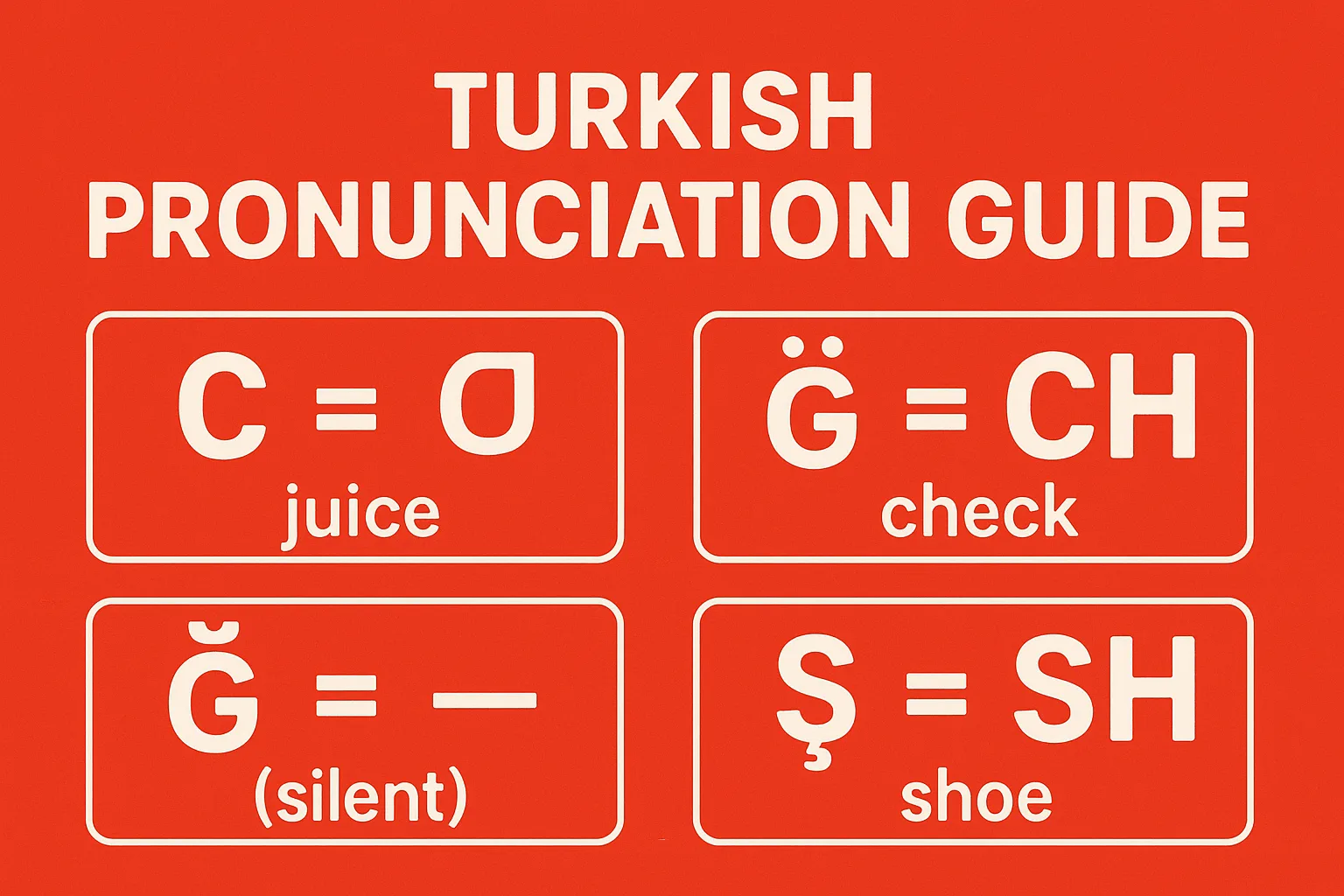
Overview Of Turkish Pronunciation
Turkish has a highly regular sound system where words are written almost exactly as they are pronounced, which makes it very friendly for learners. Each letter normally has one stable sound, and spelling exceptions are rare compared with many other languages. Once you understand the core rules about vowels, consonants and stress, you can read most new Turkish words aloud with strong confidence.
Core Features
- 29 letters in the alphabet, all written in Latin script, with several unique characters such as Ç, Ğ, I, İ, Ö, Ş, Ü.
- 8 vowels that follow clear vowel harmony rules.
- Stress usually falls on the last syllable of a word, which creates a steady rhythm.
For Learners
- Letters like I / İ and the soft Ğ are new for many learners but follow consistent rules.
- Consonant clusters are simpler than in many European languages, helping clear articulation.
- Consistent spelling supports rapid reading and listening practice.
Key Points
- Every letter is pronounced in standard speech; silent letters are unusual.
- Loanwords are gradually adapted to Turkish sound patterns.
- A focus on vowel harmony makes the language sound smooth and melodic.
Turkish Alphabet And Main Sounds
Modern Turkish uses a Latin-based alphabet of 29 letters. There are no letters Q, W, X in standard Turkish, while letters like Ç, Ğ, I, İ, Ö, Ş, Ü carry specific phonetic values. Each letter corresponds to a clear sound that stays the same in almost all contexts, which reduces guessing for learners.
Below is a simplified overview of several commonly discussed letters in pronunciation guides. It highlights approximate sounds to support your reading and listening practice without replacing careful phonetic study.
| Letter | Approximate Sound | Example (Turkish) |
|---|---|---|
| Ç ç | ch as in “chair” | çok (“very”) |
| Ş ş | sh as in “sheep” | şimdi (“now”) |
| I ı | Close, central vowel; no direct English match, often written as /ɯ/ | kız (“girl”) |
| İ i | Like English “ee” in “see” | iyi (“good”) |
| Ö ö | Rounded front vowel, similar to German ö | göl (“lake”) |
| Ü ü | Rounded front vowel, like German ü | gün (“day”) |
| Ğ ğ | “Soft g”; lengthens or smooths vowels, often very gentle in sound | dağ (“mountain”) |
This table gives only short hints. For accurate work, learners often consult audio recordings and phonetic descriptions, because the exact quality of sounds like I ı or soft Ğ ğ is best understood by careful listening and repetition.
Vowel System And Vowel Harmony
Turkish has eight vowels, and each is written with a single letter: a, e, ı, i, o, ö, u, ü. Vowels are grouped according to front vs. back and rounded vs. unrounded. This structure underlies the famous vowel harmony rules that shape many endings in the language.
- Front, unrounded vowels: e, i
- Front, rounded vowels: ö, ü
- Back, unrounded vowels: a, ı
- Back, rounded vowels: o, u
In vowel harmony, many suffixes must change their vowel to match the front/back and rounding of the last vowel in the stem. This creates a sense of flow in speech and makes Turkish words sound balanced. While the rule looks complex on paper, regular exposure helps it feel natural quite quickly.
- After a front vowel (e, i, ö, ü), suffix vowels also tend to be front.
- After a back vowel (a, ı, o, u), suffix vowels tend to be back.
- Some suffixes also harmonize for rounding, following the rounded or unrounded character of the stem vowel.
Because vowel harmony operates with such consistency, it becomes a reliable pronunciation guide. Learners can often predict the exact sound of new endings if they notice the quality of the last vowel in the word.
Consonants And Special Letters
Most Turkish consonants have values close to their counterparts in many European languages, which supports quick recognition. Still, several letters require special attention as they often cause confusion for learners who are new to the language.
- Ç ç: Always pronounced like English ch in “chair”, never like “k”.
- Ş ş: Represents the sh sound as in “shoe”; Turkish does not use sh digraphs.
- C c: Pronounced like English j in “jam”, not like “k”.
- J j: Often similar to the sound in French “je”; appears frequently in loanwords.
- R r: Typically a clear, slightly tapped alveolar r; it should not be strongly reduced at the ends of words.
- Ğ ğ (soft g): Does not have a strong consonant sound; instead it lengthens or smooths the surrounding vowels.
The letter Ğ ğ deserves particular note. In many positions it is almost silent, but it leaves an audible trace by stretching the vowel before it. Learners sometimes expect a hard “g” sound and are surprised by the gentle, soft effect it actually has.
Dotless I And Dotted İ
One of the most distinctive features of Turkish is the pair of letters I ı and İ i. These are treated as completely separate letters in the alphabet, not as mere stylistic variants. Their uppercase and lowercase forms behave differently from what many learners expect based on English.
- İ i: Dotted in both upper and lower case; sounds like English “ee” in “see”.
- I ı: Dotless in both forms; sounds like a close central vowel, often described with the phonetic symbol /ɯ/.
- Misplacing the dot can change spelling and meaning, so careful attention is useful from the very beginning.
When reading and typing, it helps to think of these letters as two separate units with their own visual identity and unique sound, rather than as variants of a single “i”. This mindset supports accurate pronuncation and fewer spelling errors.
Stress, Length And Rhythm
In most Turkish words, the main stress naturally falls on the last syllable. This rule gives spoken Turkish a steady, slightly rising energy at the end of words. Some common suffixes and place names show different patterns, but last-syllable stress is a reliable starting point for learners.
- Basic rule: Place stress on the final syllable of ordinary words.
- City names and some loanwords may have earlier stress.
- Stress can occasionally shift when certain suffixes are added, yet the spoken rhythm remains clear and regular.
Vowel length occurs in specific words, often due to older sound changes or borrowing. In such cases, the longer vowel carries a subtle weight that is important for precise pronunciation and sometimes for distinguishing between different meanings.
Common Challenges For Learners
Learners who speak English or related languages often notice a few repeating pronunciation challenges. Recognizing these typical areas makes it easier to plan focused, efficient practice.
- Dotless vs. dotted i: Differentiating I ı and İ i in both sound and spelling.
- Soft g (Ğ ğ): Avoiding a hard “g” and learning to let the vowel carry the sound.
- Front rounded vowels (ö, ü): Keeping the lips rounded while maintaining a front tongue position.
- Final consonants: Articulating sounds like k, p, t clearly at the ends of words without adding extra vowels.
- Consistent stress: Remembering last-syllable stress instead of following English stress patterns.
These points often feel unfamiliar at first, yet they respond well to short, regular practice sessions with clear models and repetition. Small adjustments in tongue position and lip shape lead to noticeable improvements.
Practical Tips For Clear Turkish Pronunciation
- Read aloud slowly, giving equal time to each syllable; this highlights the regular structure of Turkish words.
- Focus on vowels first, especially the contrast between front and back vowels, before adding fast speech.
- Listen to native speech in short segments, repeating phrases until the rhythm feels comfortable.
- Create small lists of minimal pairs such as “gül / göl” and practice hearing and saying the difference.
- Pay attention to spelling details, especially the dots on i and the presence of soft g (ğ) in words.
- Record yourself and compare your speech with a trusted audio model; small corrections add up quickly.
Because the writing system is so systematic, you can use any short, accurate text as a daily pronunciation exercise. Reading even a few lines out loud each day helps connect the letters, sounds and rhythm in a stable way.
Sample Words For Focused Practice
The following list groups a few practice words by key sound features. It can be read slowly, then more fluently, to reinforce accurate articulation and listening awareness.
- Front unrounded vowels: el (hand), bilgi (information), şehir (city).
- Front rounded vowels: göl (lake), gül (rose), sür (drive).
- Back unrounded vowels: kapı (door), baba (father), kız (girl).
- Back rounded vowels: yol (road), okul (school), yumurta (egg).
- Soft g focus: dağ (mountain), yağmur (rain), soğuk (cold).
Repeating such word sets in a calm, steady voice helps the ear notice fine differences between vowels, while the mouth gradually learns to shape each sound with less effort and more accuracy. Even when a sound feels unusual at first, it usually becomes natural with regular lisen and repetition.
References
The following sources offer reliable, detailed information on Turkish sounds, the alphabet and pronunciation rules. They can be used to deepen understanding and to check specific points in more technical depth. Using at least one trusted reference alongside regular listening practice is highly beneficial.
- Turkish Language Association (Türk Dil Kurumu) – pages on orthography and alphabet usage, including detailed spelling rules and examples: official spelling guidelines section on the TDK website.
- Undergraduate or graduate Turkish linguistics course pages from major universities (for example, phonology and phonetics course notes that cover Turkish vowels, consonants and stress patterns).
- University language centers that publish online materials for Turkish as a foreign language, often including audio-supported pronunciation guides and basic phonetic charts.
- Reference encyclopedias and well-maintained language portals that describe Turkish phonology with International Phonetic Alphabet (IPA) symbols and sample words.