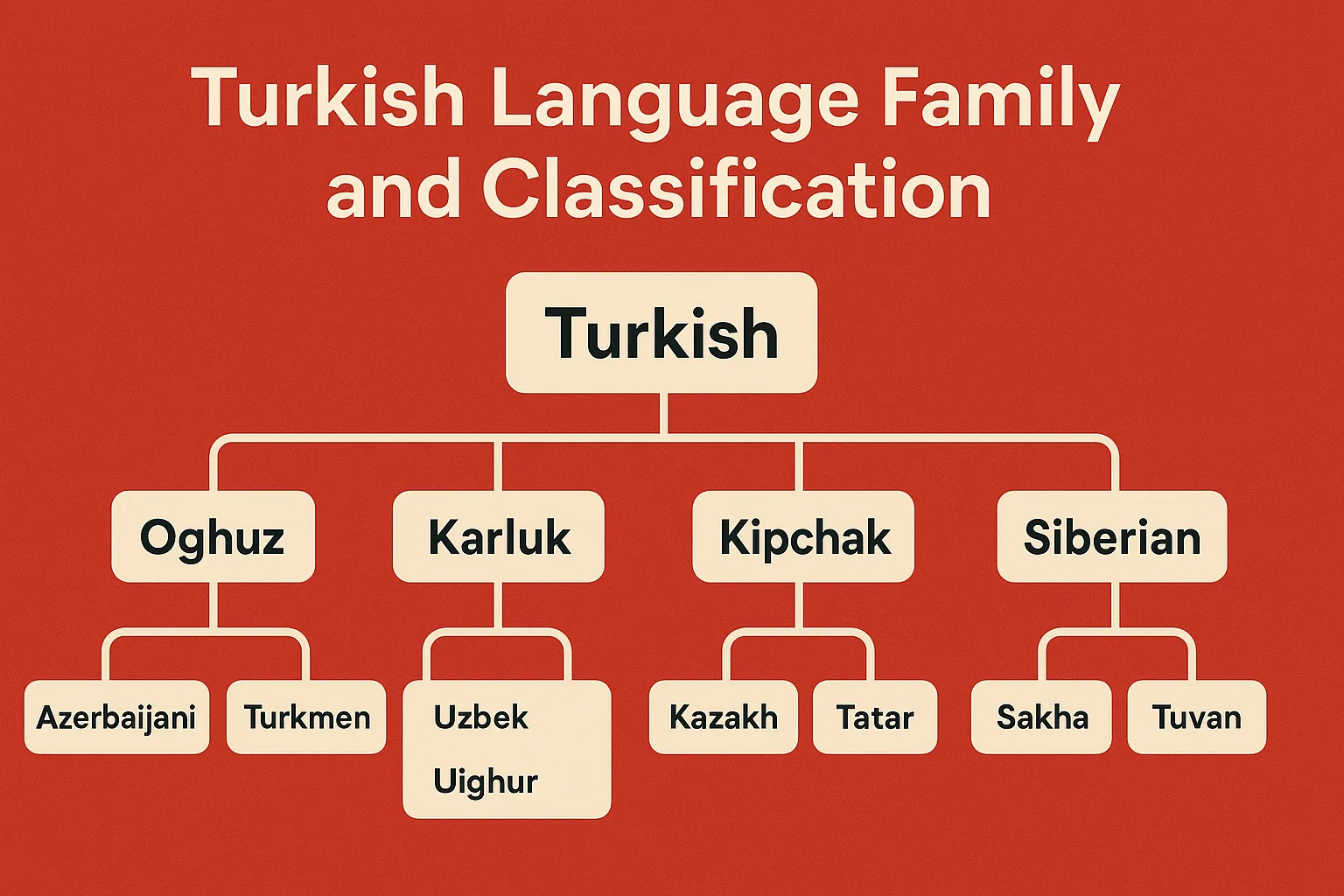
Overview Of The Turkic And Turkish Language Family
Turkish is the
largest member of the
Turkic language family,
with roughly 80–90 million speakers worldwide.
As a Western Oghuz language within the broader
Common Turkic branch,
Turkish forms a central link in a chain of related languages stretching from
Anatolia to parts of
Eastern Europe and Central Asia.
It gives a clear, concrete window into how a single standard language
can represent a much wider language family.
-
Language family:
Turkic – a family of around thirty living languages
spread across Eurasia. -
Genetic path:
Turkic →
Common Turkic →
Oghuz (Southwestern) →
Western Oghuz Turkish. -
Typology:
agglutinative morphology,
rich use of suffixes, and strong
vowel harmony. -
Writing system:
a Latin-based Turkish alphabet,
in official use since the 20th century language reform.
Main Branches Of The Turkic Family
In comparative linguistics, the
Turkic languages are usually divided into
two very broad branches, with smaller branches inside them.
This view focuses on shared sound changes,
morphological patterns and long-term contact history.
-
Oghur (Lir Turkic): a small branch represented today mainly by
Chuvash; historically spoken further west in Eurasia. -
Common Turkic: the large branch that includes
all other modern Turkic languages,
among them Turkish.
Inside Common Turkic, linguists usually talk about
several regional branches:
-
Oghuz (Southwestern):
Turkish,
Azerbaijani, Turkmen, Gagauz and several smaller varieties. -
Kipchak (Northwestern): languages such as
Kazakh, Kyrgyz, Tatar, Bashkir and others. -
Karluk (Southeastern): mainly
Uzbek and Uyghur. -
Siberian branches:
Yakut (Sakha), Dolgan, Tuvan and related languages.
This clasification explains why
speakers of Turkish often find other
Oghuz languages comparatively easy to follow,
while more distant branches such as Kipchak or Karluk require
more systematic learning.
The table below summarises the main
Turkic branches and highlights
where Turkish fits among them.
| Branch | Example Languages | Main Regions | Note On Turkish |
|---|---|---|---|
| Oghur (Lir Turkic) | Chuvash | Middle Volga region (Russia) |
Most divergent branch; Turkish does not belong here. |
| Oghuz (Southwestern) | Turkish, Azerbaijani, Turkmen, Gagauz, Qashqai | Anatolia, Azerbaijan, Turkmenistan, Balkans, Iran |
Turkish is the largest Oghuz language and the main standard of this branch. |
| Kipchak (Northwestern) | Kazakh, Kyrgyz, Tatar, Bashkir | Central Asia, Volga–Ural region |
Shares Turkic core features, but is less mutually intelligible with Turkish. |
| Karluk (Southeastern) | Uzbek, Uyghur | Central Asia (Uzbekistan, Xinjiang and surroundings) |
Shows historical ties to the same Old Turkic heritage but has undergone different sound and script developments. |
| Siberian branches | Yakut (Sakha), Dolgan, Tuvan, others | Siberia and southern Siberian mountains |
Geographically remote from Turkish; still clearly part of the Turkic family. |
Turkish Inside The Oghuz (Southwestern) Branch
Within Oghuz Turkic,
Turkish forms part of a closely knit subgroup of languages
that share many everyday words, core grammatical patterns and even idioms.
In practice, this means a Turkish speaker can usually follow at least part of a
conversation in Azerbaijani or Turkmen after some exposure.
-
Western Oghuz:
Turkish, Azerbaijani, Gagauz,
varieties of Balkan Turkish and related diasporic forms.
These are the closest relatives of standard Turkish. -
Central and Eastern Oghuz:
Turkmen, Khorasani Turkic, Qashqai,
Afshari and others spoken mainly in Iran and
Central Asia. -
Shared features: similar
sound systems,
extensive vowel harmony, and comparable
verb conjugation patterns. -
Differences: each Oghuz language has its own
phonetic traits,
loanword layers and standardised orthography.
Historical Development Of Turkish
The place of modern Turkish
in the Turkic family becomes clearer when its historical stages are viewed as a sequence.
Each stage refines the language’s position within
Oghuz Turkic.
-
Proto-Turkic and Early Turkic:
the reconstructed ancestor of all Turkic languages,
attested indirectly through early inscriptions and comparative work. -
Oghuz migrations: tribes speaking
Oghuz Turkic moved westward,
eventually settling in Anatolia and neighbouring regions. -
Old Anatolian Turkish: the first major written form of
Turkish in Anatolia,
visible in literary and administrative texts from the late Middle Ages. -
Ottoman Turkish: a prestigious written variety with
heavy Arabic and Persian influence in vocabulary and style;
structurally still a Turkic Oghuz language. -
Modern Standard Turkish: based mainly on
Istanbul Turkish,
written in the Latin alphabet and used today in education, media and public life.
Structural Features Relevant To Classification
Several core structural properties
link Turkish to other Turkic languages and, more specifically, to the
Oghuz branch. These properties are central in genetic classification.
-
Agglutinative morphology: words are built by adding
suffixes in a fixed order.
For example, in a form like evlerinizden (“from your houses”),
each ending expresses one grammatical meaning. -
Vowel harmony: suffix vowels change to match the
front/back and
rounded/unrounded quality of the root vowel.
This pattern is typical for Turkic languages. -
Sound changes shared with Oghuz languages:
features such as the development of k to
ğ in certain positions,
and specific patterns in final consonants, align Turkish with
Azerbaijani and Turkmen. -
Basic word order:
subject–object–verb (SOV),
with extensive use of postpositions and non-finite verb forms, as in other Turkic languages. -
Case system and evidentiality:
rich case marking for nouns and
evidential forms in the verb interact in similar ways across the
Oghuz subgroup.
Geographic Distribution And Standard Variety
The modern position of Turkish
in the language family is also reflected in how widely it is spoken and in which
standard forms are recognised.
-
Official status: Turkish is the national language of
Turkey and an official language in
parts of Cyprus, with recognised status in several other states and regions. -
Speaker numbers: there are around
80+ million native speakers,
and the total number of people who can speak Turkish (as a first or second language)
is often estimated near 90 million. -
Dialects within Turkish:
Anatolian dialects,
Rumelian (Balkan) Turkish, Cypriot Turkish and other regional forms.
These varieties all remain within the Oghuz subgroup. -
Turkish as a bridge language: because it is the
best-known Turkic language worldwide,
it often serves as a starting point for learners interested in
Azerbaijani, Turkmen or even more distant Turkic languages.
External Relationships Of Turkish
Historically, scholars proposed a wider
Altaic family that would group
Turkic together with Mongolic, Tungusic and sometimes Koreanic and Japonic languages.
Today, most linguists treat Turkic
as an independent family, while still recognising long-term contact and some areal similarities.
-
Older proposals: the
Altaic and “Ural–Altaic” hypotheses tried to connect
Turkish with languages such as Finnish or Japanese on genetic grounds. -
Current mainstream view:
no proven genetic link has been established;
similarities are explained mainly through contact and
shared areal features. -
Practical consequence: in academic work,
Turkish is classified simply as a
Turkic, Oghuz, Western Oghuz language,
without assuming a larger confirmed macro-family.
Why This Classification Matters For Learners
For learners and teachers, the
family position of Turkish
is not just a theoretical label; it has practical value for planning study paths
and comparing structures across languages.
-
Predicting similarity: knowing that Turkish is
Western Oghuz
lets learners anticipate high similarity with Azerbaijani and
Turkmen, and lower similarity with Kazakh or Uzbek. -
Re-using grammar knowledge: once a learner masters
vowel harmony,
agglutination and SOV word order in Turkish,
much of that knowledge transfers directly to other Turkic languages. -
Understanding contact effects: the
historical layers of Arabic, Persian and European
loanwords in Turkish become easier to interpret when one sees Turkish as a
Turkic core language with rich contact history. -
Placing Turkish on the world map: family classification shows
how Turkish relates not only to
its closest neighbours but also to the broader typological landscape of
world languages.