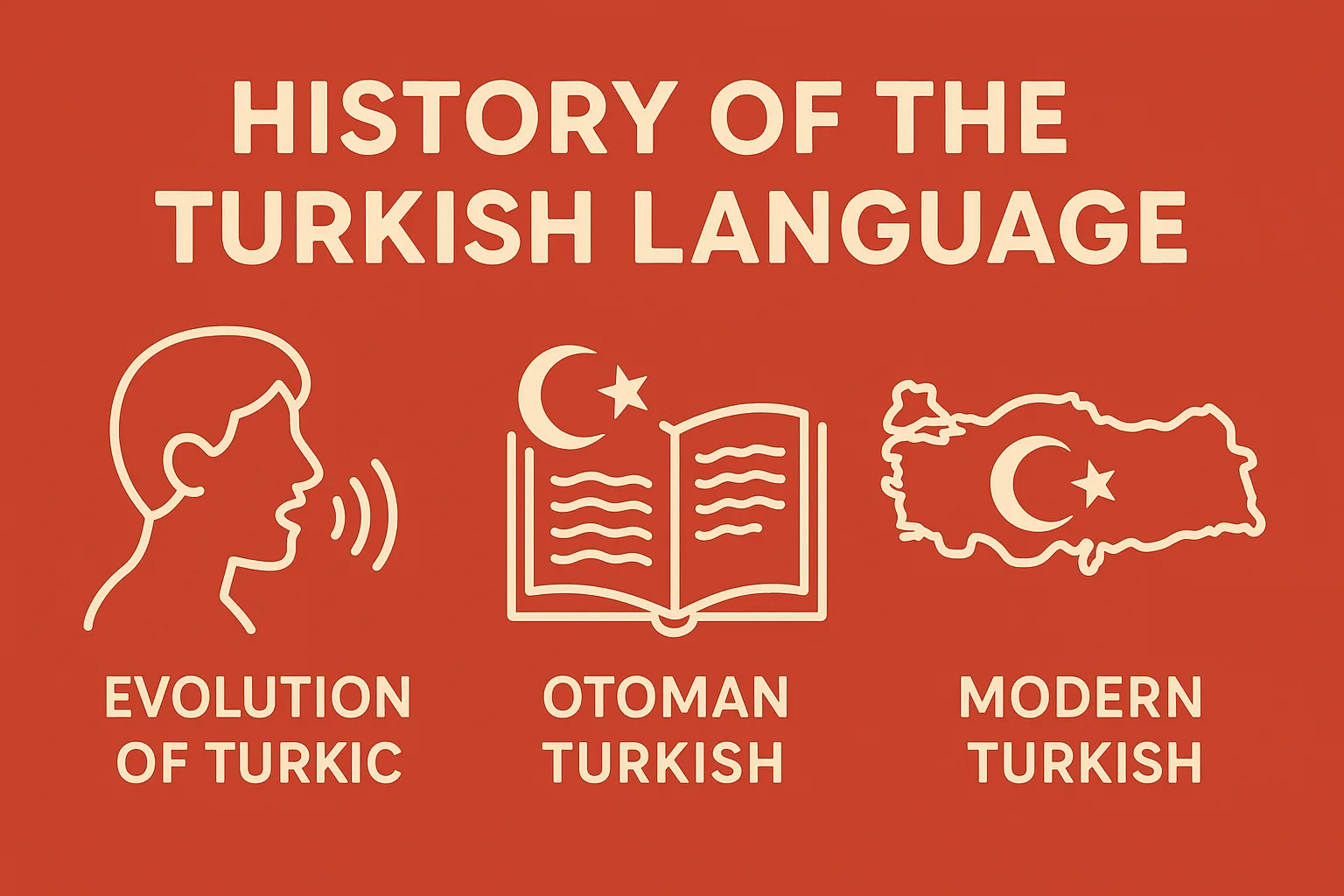
Turkish is a major world language and the most widely spoken member of the Oghuz branch of the Turkic language family. From the earliest inscriptions in Central Asia to its role as the official language of the Republic of Turkey, the story of Turkish is a continuous line of migration, cultural contact and deliberate language planning.
Essential Information
- Language family: Turkic > Oghuz
- Standard variety: Istanbul Turkish
- Official status: Turkey and the Turkish Republic of Northern Cyprus, co-official in the Republic of Cyprus
- Speakers: tens of millions of native speakers in Turkey and large diaspora communities in Europe and the Middle East
- Writing system today: Latin-based Turkish alphabet since 1928
Main historical periods
- Old Turkic (8th–13th centuries)
- Old Anatolian Turkish (13th–15th centuries)
- Ottoman Turkish (15th–early 20th century)
- Modern Turkish (20th century to today)
1. Turkish within the Turkic language family
The Turkic languages form a group of more than thirty related languages spread from Eastern Europe to Western China. Turkish belongs to the Western Oghuz subgroup together with languages such as Azerbaijani and Turkmen. All Turkic languages share key structural features: an agglutinative morphology, extensive vowel harmony and a basic subject–object–verb word order.
Linguists often reconstruct an earlier stage called Proto-Turkic, spoken by nomadic communities in Central Asia. Over many centuries these communities moved westward, and their descendants eventually brought Oghuz Turkic dialects to Anatolia, where the modern Turkish language would later emerge.
2. Old Turkic and the first written records
The earliest known written examples of a Turkic language are the Orkhon inscriptions from the 8th century CE, found in the Orkhon Valley of present-day Mongolia. They are carved in an angular script sometimes called the Old Turkic runic alphabet. These monumental texts commemorate rulers of the Göktürk (Kök Türk) empire and show a fully developed literary tradition.
After the Göktürk period, other communities used different writing systems for closely related varieties of Old Turkic, including:
- Uyghur script for Buddhist and Manichaean texts
- Arabic script for Islamic religious and scientific works
- Greek and Armenian scripts in certain multilingual communities
These early monuments already display features still central to modern Turkish, such as vowel harmony and an agglutinative structure where long words are built from a root plus a chain of suffixes.
3. From Central Asia to Anatolia
From the 11th century, Oghuz-speaking Turkic groups moved into Iran and Anatolia under the Seljuk Turks. With the spread of Islam, Turkish speakers were gradually in contact with Persian-speaking and Arabic-speaking communities. Persian became the dominant language of administration and literature in many courts, while Arabic dominated religious scholarship.
In this setting, the spoken Oghuz dialects of Anatolia began to evolve into Old Anatolian Turkish. The vocabulary absorbed many Persian and Arabic words, yet the underlying grammar remained clearly Turkic. This mixture laid the foundations of later Ottoman Turkish.
4. Old Anatolian Turkish (13th–15th centuries)
Between the 13th and 15th centuries, authors in Anatolia began to use Turkish more systematically for poetry, prose and religious works. This stage, often called Old Anatolian Turkish, shows a language closer to everyday speech than the later Ottoman court style, while still drawing heavily on Persian and Arabic for technical and literary vocabulary.
Texts from this period are important because they:
- Document the transition from Central Asian Turkic varieties to an Anatolian standard
- Preserve early examples of Turkish Sufi literature and folk poetry
- Show how Islamic concepts were expressed in a Turkic language
For learners today, Old Anatolian Turkish reveals how many modern words have older Persian or Arabic layers beneath their current, often more “pure Turkish” forms.
5. Ottoman Turkish: a layered literary language
By the time of the Ottoman Empire, the written standard known as Ottoman Turkish had become a highly prestigious, but complex, language. It combined:
- Turkish grammar and core vocabulary
- A very large number of Arabic religious and scientific terms
- Extensive Persian poetic and administrative vocabulary
Ottoman Turkish was written in a version of the Arabic script. Because this script does not fully represent Turkish vowels, reading and writing required substantial training. A clear distance developed between the high literary language of the court and bureaucracy and the more colloquial Turkish spoken by the wider population.
This situation created a kind of diglossia: the same community used different forms of the language in different settings. For historians and advanced learners, Ottoman texts are a rich source for understanding how Turkish interacted with neighbouring Islamic literary traditions.
6. Scripts and alphabets across the centuries
Throughout its history, Turkish has been written in several different scripts. Each alphabet change reflects a broader cultural and political shift, from Central Asian empires to the modern Turkish Republic. The simplified table below summarises the main stages in a way that language learners can use as a quick reference.
| Period | Approx. dates | Main script | Key features for learners |
|---|---|---|---|
| Old Turkic | 8th–13th centuries | Old Turkic runic, Uyghur | Early inscriptions; mainly of interest to specialists and advanced students |
| Old Anatolian Turkish | 13th–15th centuries | Arabic-based scripts | Bridge between Central Asian and Anatolian stages; early religious and literary works |
| Ottoman Turkish | 15th–early 20th century | Arabic script (Ottoman variant) | Heavy Arabic/Persian vocabulary; important for reading historical documents |
| Modern Turkish | From 1928 | Latin-based Turkish alphabet | Very regular spelling; easier literacy and access for new learners |
7. Language reform and the birth of modern Turkish
After the establishment of the Republic of Turkey in 1923, language became a central focus of cultural reform. In 1928, a new Latin-based alphabet was officially adopted to replace the Arabic script. The new letters were designed so that each Turkish sound corresponded closely to a single symbol, making reading and writing far more transparent.
In 1932, the Turkish Language Association (Türk Dil Kurumu) was founded to carry out systematic research on Turkish and to guide language policy. Among its aims were:
- Promoting scientific study of Turkish and other Turkic languages
- Preparing dictionaries and grammars for the new standard language
- Encouraging the replacement of some Arabic and Persian loanwords with new Turkish-based terms
Many familiar words in present-day Turkish, such as yurttaş (“citizen”) or saygı (“respect”), became more common in this reform era, as alternatives to older forms. Not every proposed neologism survived, but the overall effect was a clear, modern standard that is still recognisable as part of the wider Turkic language continuum.
8. Modern standard Turkish and its varieties
Contemporary standard Turkish is based on the Istanbul dialect. It is taught in schools, used in national media and serves as a common written norm for Turkish speakers worldwide. At the same time, a rich mosaic of regional varieties continues to exist across Anatolia, Thrace, the Balkans and the Middle East.
Some varieties show small differences in pronunciation and vocabulary, while others, like Cypriot Turkish or Balkan dialects, preserve older features influenced by local contact languages. For learners, exposure to these varieties can make listening skills stronger and demonstrate how flexible the language really is.
Outside Turkey, large Turkish-speaking communities in countries such as Germany, the Netherlands, France and the United Kingdom use Turkish alongside local languages. This leads to natural bilingual practices, code-switching and the borrowing of modern terms, especially in areas like technology, popular culture and youth speech.
9. Turkish in the digital age
The Latin-based Turkish alphabet has made it easy to use Turkish on computers, smartphones and online platforms. Standardised spelling and punctuation mean that search engines, automatic translation tools and language-learning applications can handle Turkish text relatively well compared with languages that use more complex scripts.
At the same time, digital communication encourages creativity. Users frequently combine colloquial Turkish with English loanwords, emojis and abbreviations. New expressions spread quickly through social media, showing that Turkish remains a living, adaptable language that continues to respond to cultural and technological change.
10. Why the history of Turkish matters for learners
For anyone studying Turkish, understanding its history is not just an abstract exercise. It helps explain why synonyms sometimes come in pairs, with one term of Arabic or Persian origin and another created from Turkic roots. It also makes it easier to recognise shared vocabulary with related languages such as Azerbaijani or Turkmen.
A historical perspective also:
- Clarifies why older texts use the Arabic script and different spelling conventions
- Shows how language reform shaped modern Turkish identity
- Highlights the connections between Central Asia, Anatolia and the Balkans through a shared linguistic heritage
By tracing the path from Old Turkic inscriptions to today’s standard language, learners can see Turkish as part of a broader story of continuity and renewal. This viewpoint turns every new word, suffix or expression into a small piece of a much larger historical puzzle.
References
-
Encyclopaedia Britannica – “Turkish language” – Overview of the language, its position in the Turkic family, and the main phases from Old Anatolian to modern standard Turkish.
https://www.britannica.com/topic/Turkish-language -
Encyclopaedia Britannica – “Ottoman Turkish language” – Detailed discussion of Ottoman Turkish and its relationship to Old Anatolian Turkish and modern Turkish.
https://www.britannica.com/topic/Ottoman-Turkish-language -
Encyclopaedia Britannica – “Turkic languages” – Background on the wider Turkic family, including structural features such as agglutination and vowel harmony.
https://www.britannica.com/topic/Turkic-languages -
Turkish Language Association (Türk Dil Kurumu) – Official institution responsible for research on Turkish and for many aspects of language planning and standardisation.
https://www.tdk.gov.tr -
Wikipedia – “Turkish language” – Broad, regularly updated overview of the language, its history, phonology, grammar and geographic distribution, with extensive bibliography.
https://en.wikipedia.org/wiki/Turkish_language