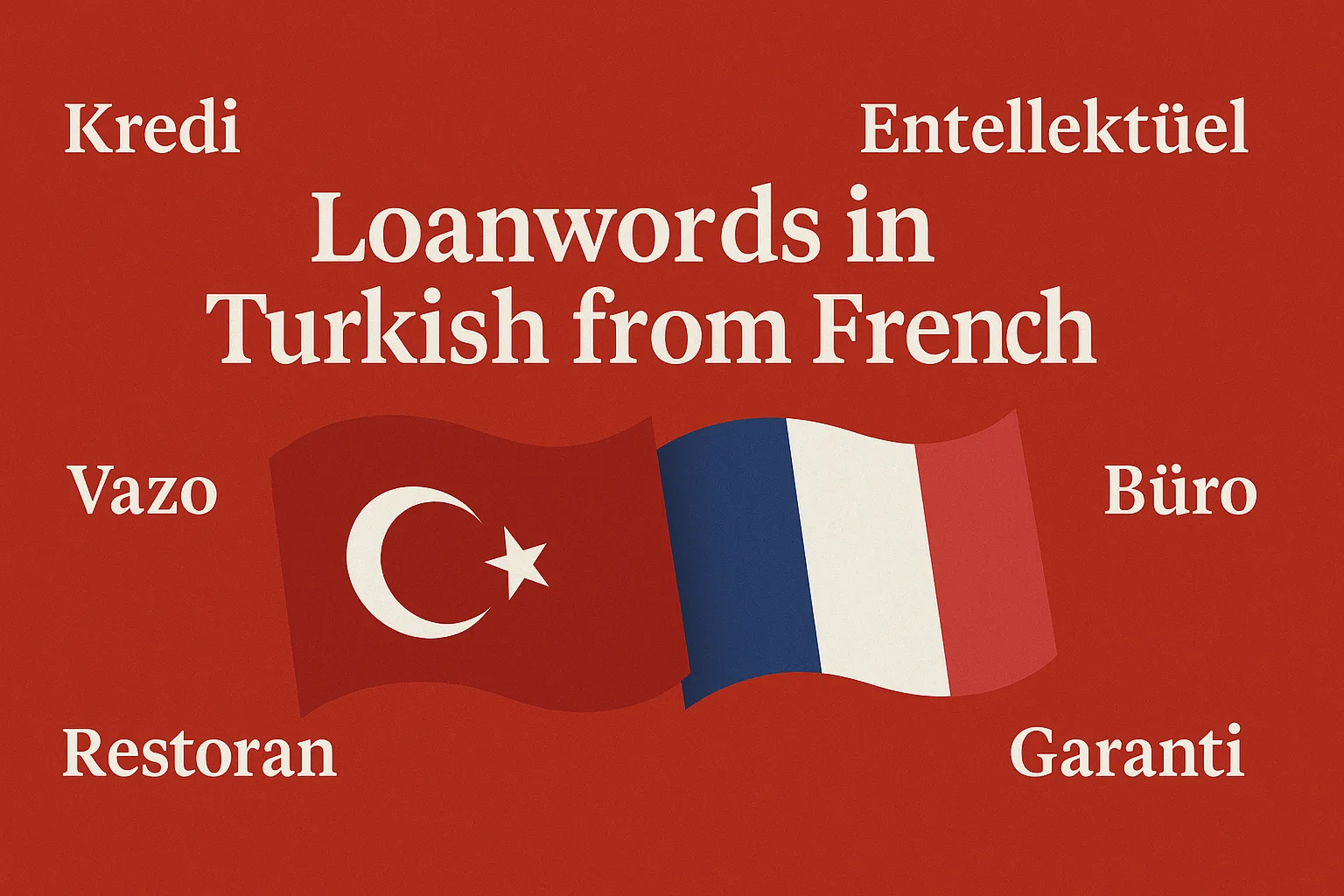
French loanwords in Turkish are not a curiosity; they are a working layer of modern vocabulary. Many entered Turkish during periods when French carried prestige in education, administration, publishing, and urban life. The result is a set of words that often feel “native” today—pronounced, spelled, and used in a distinctly Turkish way.
What This Topic Covers
- What counts as a French-origin loanword in Turkish.
- How words moved from French into Ottoman Turkish and Modern Turkish.
- Typical patterns in spelling and pronunciation.
- High-frequency examples with practical notes for readers.
Quick Orientation
- Loanword: a word borrowed from another language and adapted for local use.
- French-origin: the immediate source is French, even if the term had an older history elsewhere.
- Adaptation: Turkish reshapes the word to fit sound, spelling, and grammar.
A loanword is like a passport stamp: it shows where the word has been, while the word still “lives” in its new home as everyday Turkish.
Historical Context
- 18th–19th centuries: French gained visibility through diplomacy, military modernization, and new professional fields.
- Tanzimat and later reforms: French became strongly associated with modern institutions, press culture, and technical terminology.
- Early Republic: language planning encouraged standardization, yet many French-origin words stayed due to frequency and utility.
Why French in particular? In many modernization pathways, French served as a bridge language for science, law, administration, and urban culture. A single borrowed term could travel quickly because it arrived with a new concept, a new object, or a new habit.
Main Routes of Borrowing
- Education and publishing: textbooks, translations, newspapers, and magazines helped normalize French-derived terminology.
- Administration and professions: many terms came attached to institutions and procedures rather than casual speech.
- Technology and infrastructure: new systems (transport, buildings, devices) often carried French labels at the point of introduction.
- Fashion and urban life: clothing, social spaces, and services brought a visible cluster of French-origin words.
Common French Loanwords in Turkish
The table below lists high-frequency examples. Each item shows a typical adaptation: Turkish spelling becomes more phonetic, and the word fits Turkish suffix patterns with ease.
| French Source | Turkish Form | Meaning in English | Notes |
|---|---|---|---|
| abat-jour | abajur | lampshade | spelling matches Turkish sounds |
| ascenseur | asansör | elevator | -eur → -ör |
| billet | bilet | ticket | very common in travel |
| bureau | büro | office | vowel adapted to Turkish |
| buffet | büfe | snack bar; buffet | shift toward small food kiosk is common |
| garage | garaj | garage | -age → -aj |
| garçon | garson | waiter | final sound made Turkish-friendly |
| coiffeur | kuaför | hairdresser | cluster simplified |
| maquillage | makyaj | makeup | -age → -aj |
| mannequin | manken | model | spelling aligns with pronunciation |
| menu | mönü | menu | often seen in restaurants |
| montage | montaj | assembly; installation | frequent in industry |
| reportage | röportaj | interview; feature report | media term, widely used |
| rendez-vous | randevu | appointment | meaning narrowed to scheduled meeting |
| paletot | palto | coat | shortened form is typical |
| pantalon | pantolon | trousers | stable everyday item |
| tunnel | tünel | tunnel | vowel adaptation: u → ü |
| toilette | tuvalet | toilet; restroom | fits Turkish suffixing: tuvalete, tuvaletten |
Typical Spelling and Sound Patterns
French-origin words in Turkish often share visible fingerprints. These patterns help readers recognize a likely borrowing, even before checking a dictionary for origin and original spelling.
- -age becoming -aj: garage → garaj, maquillage → makyaj.
- -tion turning into -syon or -siyon in many technical terms: station → istasyon, organisation → organizasyon.
- -eur / -euse often mapping to -ör (and similar endings): ascenseur → asansör, chauffeur → şoför.
- ch frequently appearing as ş in Turkish spelling: chauffeur → şoför.
- accented vowels disappear, but the pronunciation stays “rounded” where Turkish allows it: büro, mönü, tünel.
How Turkish Makes These Words Feel Native
- Suffix compatibility: once borrowed, words behave like Turkish nouns: randevu → randevular, randevuda.
- Stress patterns: Turkish stress habits often reshape how the word is heard, even when the spelling stays close.
- Spelling regularization: Turkish orthography prefers a more consistent sound-to-letter feel, so the written form becomes clearer over time.
That naturalization can happen quickly. A borrowed term may feel like an outsider on day one, then become ordinary speech after repeated use in schools, offices, and daily routines. That shift has occured many times in Turkish history.
Meaning Shifts and Usage Notes
Borrowing is rarely a perfect photocopy. Some words keep their general meaning, while others develop a Turkish-specific usage. This is where readers benefit most from clear examples.
- büfe (buffet): in Turkish it often means a small kiosk or snack counter, not only a buffet meal.
- röportaj (reportage): commonly used for an interview or journalistic feature in Turkish.
- randevu (rendez-vous): narrowed to a scheduled appointment, especially medical and official contexts.
- montaj (montage): frequently used for installation/assembly work, not just film editing.
- garson (garçon): fixed meaning as waiter in Turkish, without the broader “boy/young male” sense.
How to Identify Likely French-Origin Words
- Look for endings like -aj, -syon, -ör, -man/-men (as in manken).
- Check semantic clusters: fashion, service jobs, media terms, and public infrastructure contain dense pockets of French loanwords.
- Confirm with a dictionary: reliable Turkish dictionaries often list the source language and sometimes the original form.
Practical Benefits for Learners and Writers
- Faster vocabulary growth: readers who know French (or recognize international terms) can often guess meaning with high accuracy.
- Cleaner translation: spotting a loanword helps decide whether to keep an international term or choose a local equivalent.
- Better spelling intuition: noticing the pattern (like -aj) reduces guesswork.
- Register awareness: some French-origin items feel formal or institutional, while others are fully casual.
A small bonus: French-origin vocabulary can act as an intersting map of modernization—showing which domains expanded first and which terms became everyday speech.
Editorial Guidance for Language Pages
- Prefer clarity over drama: loanwords are a normal outcome of contact, trade, education, and technology.
- Use consistent fields when listing examples: source form, Turkish spelling, meaning, and a short usage note.
- Separate origin from popularity: a French-origin word can be fully mainstream, while another may feel specialized.
- Avoid over-claiming: some words resemble French but arrived via other languages; a dictionary check keeps the page precise.