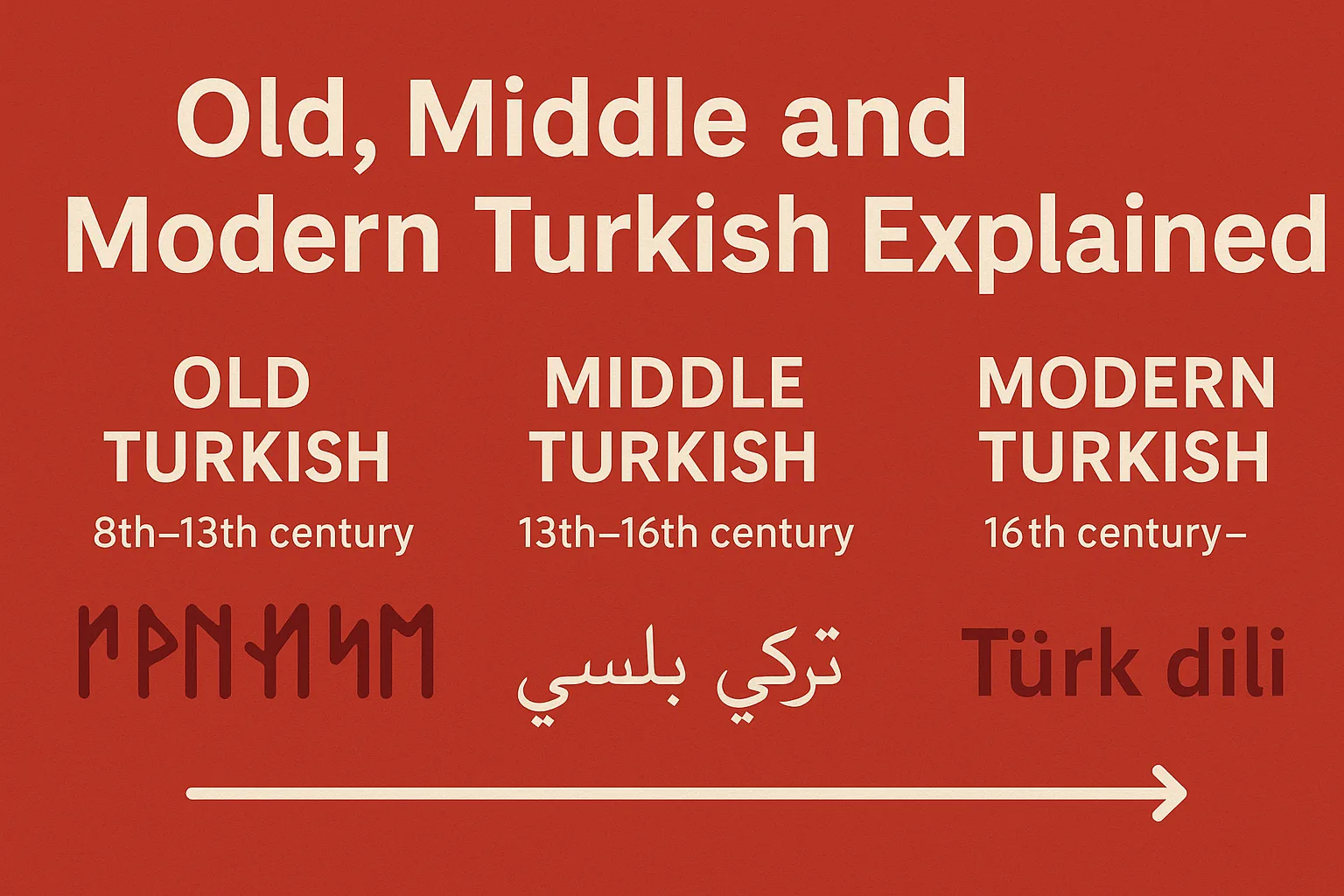
Understanding Old, Middle and Modern Turkish as Historical Stages
The Turkish language is often described in three broad historical layers: Old Turkish, Middle Turkish and Modern Turkish. These labels help us follow how a single Turkic language family moved from Central Asian empires to Anatolian cities and today’s republics, while preserving a recognisable core structure.
Turkish belongs to the Oghuz branch of the Turkic languages, which stretches from modern Türkiye to Central Asia. Over time, the language moved from early runic-style inscriptions to rich manuscript traditions and finally to a Latin-based alphabet, without losing its typical vowel harmony or agglutinative word-building style.
When linguists say Old, Middle and Modern Turkish, they are not naming three separate languages. They describe three main phases of one long continuum, marked by changes in script, power centres, religion and cultural contacts, especially with Arabic, Persian and later European languages.
Historical linguistics perspectiveSame grammar heart, different historical faces – this is a useful way to picture the relation between Old, Middle and Modern Turkish.
Short timeline of the three stages
- Old Turkish (Old Turkic): roughly 7th–10th centuries – earliest inscriptions and manuscripts in Central Asia, mostly before Islamisation, written in Old Turkic runiform and later Uyghur script.
- Middle Turkish: roughly 10th–15th centuries – expansion of Islamic literature in Karakhanid, Khwarezm, Kipchak and Oghuz varieties, including Old Anatolian Turkish in Anatolia, usually in an Arabic-based script.
- Modern Turkish: from the late Ottoman and especially 20th century to today – a standardised form based largely on the Istanbul dialect, written in a Latin alphabet and used as the official language of the Republic of Türkiye.
Watch: visual overview of Turkish language history
Old Turkish (Old Turkic): 7th–10th Centuries
Old Turkish, often called Old Turkic, refers mainly to the earliest written forms of Turkic used by steppe empires in Central Asia. The most famous examples are the Orkhon and Yenisei inscriptions, carved in a distinctive runiform script and commemorating political and military events. Even in these early texts, we see a clear subject–object–verb (SOV) order and rich suffix chains that will feel familiar to speakers of Modern Turkish.
Old Turkish was written first in the Old Turkic (Göktürk) runiform script, later also in the Uyghur script. No single spoken standard existed; instead, scripts recorded the language of powerful clans and courts. The vocabulary is mainly native Turkic, with only limited contact vocabulary compared to later periods, which makes many roots surprisingly transparent to modern readers once they master the older phonetic system.
Key structural traits of Old Turkish include:
- Agglutinative morphology: many suffixes attach in a fixed order to a simple stem, just as in ev-ler-in-de in Modern Turkish.
- Vowel harmony already clearly active, guiding the choice of suffix vowels.
- Case system marking functions such as subject, object, direction and location with regular endings.
- Lexicon dominated by native roots related to politics, warfare, pastoral life and shamanic beliefs.
For learners and readers today, Old Turkish texts show that many core grammar patterns are older than the Ottoman Empire or the Republic; what changes most over time are the scripts, orthography and layers of loanwords.
Middle Turkish: 10th–15th Centuries
Middle Turkish covers a wide family of written varieties that emerged after the spread of Islam among Turkic peoples. It includes Karakhanid Turkish, Khwarezm and Kipchak Turkish in Central Asia, and later Old Anatolian Turkish in Anatolia. Together these traditions form a bridge between early steppe inscriptions and the Ottoman literary language.
Most Middle Turkish texts use an Arabic-based script, adapted for Turkic sounds. Religious works, legal texts, poetry and didactic literature flourished, often produced at courts and madrasas. This period also brings intensive contact with Arabic and Persian, which adds new layers of vocabulary for theology, philosophy, administration and poetry.
In Old Anatolian Turkish (roughly 13th–15th centuries), Oghuz Turkic reaches Anatolia and begins to develop a written standard. Texts from Sufi circles, Anatolian beyliks and early Ottoman centres show a language already close to later Ottoman Turkish, but with somewhat simpler sentence structures and a more transparent Turkic core.
Some characteristic tendencies of Middle Turkish are:
- Script shift towards the Arabic alphabet, sometimes with additional marks to show Turkic vowels.
- Lexical enrichment from Arabic and Persian, especially in learned and literary registers.
- Persistence of SOV word order and agglutinative suffix chains in everyday grammar.
- Emergence of regional written standards (Central Asian vs. Anatolian) within the broader Turkic continuum.
For historical study, the Middle Turkish period is important because it shows how a nomadic imperial language adjusted to Islamic urban cultures, while staying structurally close to the Old Turkish layer and laying the foundation for Ottoman and Modern Turkish.
Modern Turkish: From Ottoman Heritage to Republican Reform
What we call Modern Turkish grows out of the Ottoman Turkish written tradition, which dominated from about the 15th century until the early 20th century. Ottoman Turkish used an Arabic-based script and combined a Turkic grammatical base with large numbers of Arabic and Persian loanwords, sometimes giving the language a layered feel between everyday speech and courtly, highly ornate writing.
In the Republican period, especially after 1923, language policy became a central tool of modernisation. The most visible change was the alphabet reform of 1928, which replaced the Ottoman script with a Latin-based Turkish alphabet designed to reflect pronunciation more clearly and to raise literacy. This reform also made it easier for learners to connect written and spoken forms without mastering an older script.
Alongside the alphabet, there were efforts to simplify vocabulary, promote native Turkic words and standardise grammar and spelling. Many everyday terms were replaced or re-shaped, while technical and scientific vocabulary often came from European languages. The resulting Standard Modern Turkish, based mainly on the Istanbul dialect, is now used in administration, education, media and international communication.
Despite these reforms, Modern Turkish still shows continuity with its earlier stages in its core grammar: agglutinative morphology, vowel harmony and SOV order remain central, and many historical roots survive beneath new layers of meaning. This langauge continuity is what allows specialists to move across centuries of texts with the help of philological training.
Key Differences Overview
The table below summarises some of the most visible contrasts between Old, Middle and Modern Turkish, focusing on features that matter for historical reading and linguistic comparison.
| Feature | Old Turkish | Middle Turkish | Modern Turkish |
|---|---|---|---|
| Approximate dates | 7th–10th c. | 10th–15th c. | 20th c. onwards (with roots in late Ottoman) |
| Main regions | Central Asian steppe empires (e.g. Göktürk, Uyghur) | Central Asia and Anatolia (Karakhanid, Khwarezm, Kipchak, Old Anatolian) | Republic of Türkiye and neighbouring areas, plus a wide diaspora |
| Writing systems | Old Turkic runiform, later Uyghur script | Mostly Arabic-based script adapted to Turkic | Latin-based Turkish alphabet since 1928 |
| Lexical profile | Primarily native Turkic roots | Blend of Turkic base with Arabic–Persian loanwords, especially in religious and literary texts | Standardised vocabulary; many native or re-created Turkic terms plus international scientific and technical words |
| Typical text types | Inscriptions, royal memorials, some legal and religious fragments | Religious treatises, didactic works, poetry, legal texts | Administration, education, literature, media and digital communication |
| Difficulty for modern readers | High: different script and historical phonology require specialised training | Medium to high: Arabic script and dense loanwords can be challenging | Low for native speakers and learners with standard grammar knowledge |
What Stays the Same Across All Three Stages
Despite the impressive historical distance, Old, Middle and Modern Turkish share a common structural backbone. This continuity allows linguists to trace patterns across manuscripts and helps learners see older texts as part of one evolving system rather than three isolated languages.
- Agglutination: words are built from a stem plus orderly suffixes, conveying grammatical categories such as person, tense, case and possession.
- Vowel harmony remains a central principle, with suffix vowels adapting to the quality of the stem; details change, but the idea of harmony persists from early inscriptions to modern speech.
- SOV syntax is dominant in narrative prose and many poetic lines, even if focus or emphasis can move elements to the front of the sentence.
- Core vocabulary for family, basic actions and natural phenomena often shows direct cognates between Old Turkic forms and Modern Turkish words.
From a structural point of view, then, historical change in Turkish is gradual rather than abrupt; what looks like a radical break from the outside (for example, the alphabet reform) often leaves deeper grammatical patterns intact.
Why These Stages Matter for Learners and Readers
Understanding the labels Old, Middle and Modern Turkish helps students, researchers and heritage speakers organise a very long history into manageable units. Each stage points to a cluster of scripts, text types and cultural contexts, which can then be explored systematically.
- For linguistics and philology, the stages provide a structure to study sound change, morphology and syntax across more than a millennium of Turkic documentation.
- For literature and history, they mark key shifts from stone monuments to manuscript culture and then to print and digital media.
- For language learners, they clarify why some Ottoman-era words feel distant, while many everyday Modern Turkish forms still reflect very old patterns.
Seeing Turkish as a continuous but layered tradition makes it easier to appreciate both its historical depth and its modern flexibility, whether one reads inscriptions, medieval chronicles or contemporary novels.
References
- Türk Dil Kurumu (TDK) Belleten, “Eski Anadolu Türkçesinin Türk Dili Tarihindeki Yeri” – article on the place of Old Anatolian Turkish in the history of the Turkish language.
- DergiPark, “Türk Dilinin Geçirdiği Devreler” – scholarly overview of Old Turkish, Middle Turkish and later stages with periodisation and examples.
- Wikipedia – Old Anatolian Turkish – encyclopaedic summary of Old Anatolian Turkish (Old Oghuz Turkish) as a stage between Middle and Ottoman Turkish.
- Ankara University, Faculty of Languages, History and Geography – Department of Turkish Language and Literature – departmental description emphasising research and teaching on historical stages of Turkish.
- Hacettepe University – Turkish Language and Literature Department – program information highlighting courses on Classical Turkish Literature, Turkish Language and Modern Turkish Literature.