Overview
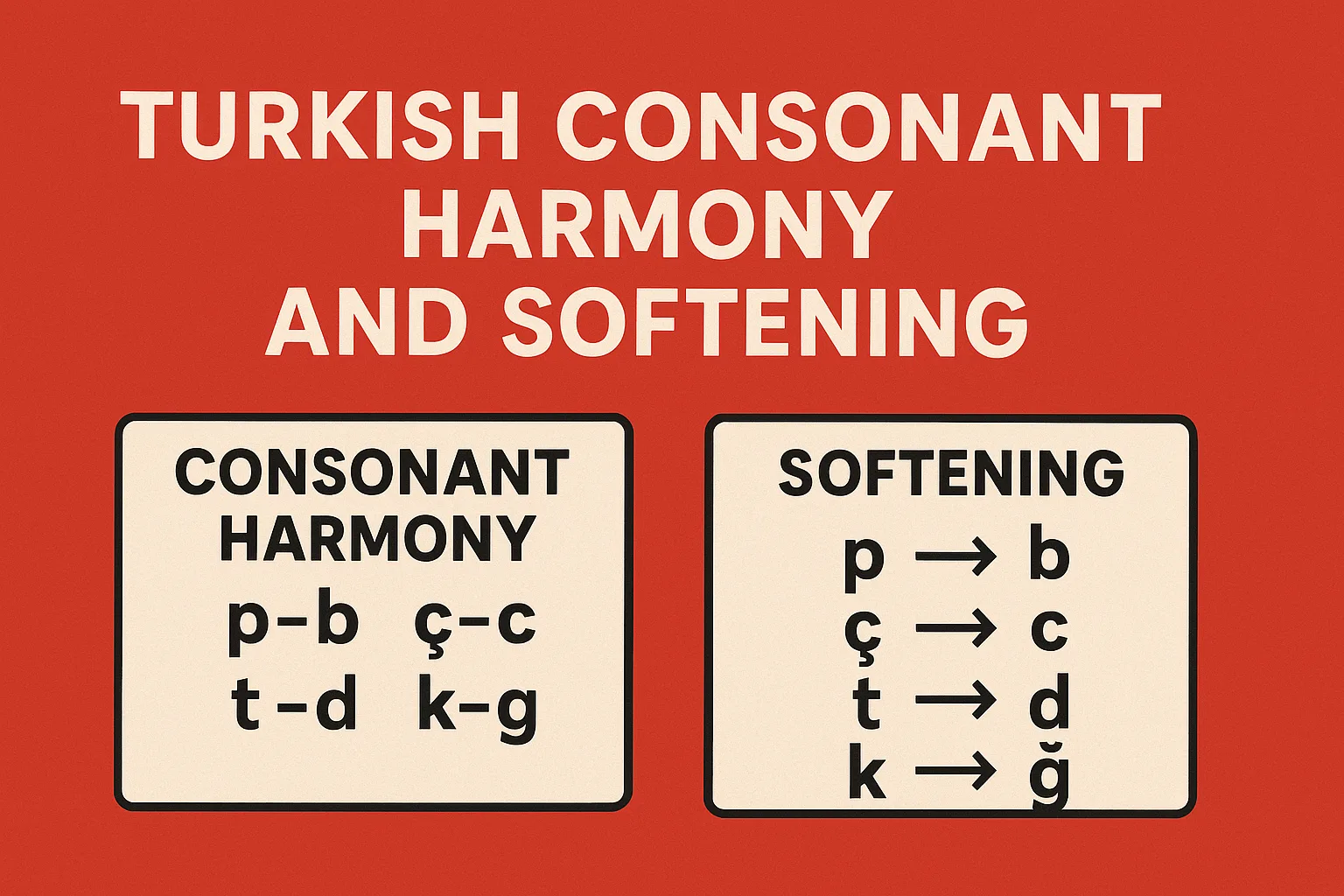
Turkish consonant harmony and consonant softening describe how Turkish consonants adjust their voicing and strength so that words and suffixes sound smooth together. These regular sound patterns are not decoration; they are essential for correct spelling, pronunciation and natural fluency in modern Turkish.
Consonant harmony (ünsüz uyumu) mainly means:
- Suffix consonants like -d-, -c-, -g- change after certain “hard” consonants.
- They turn into -t-, -ç-, -k- so that voicing matches the last consonant of the stem.
- This is sometimes called the “hardening” part of consonant harmony.
Consonant softening (ünsüz yumuşaması) means:
- Final p, ç, t, k in many words become b, c, d, ğ when a vowel-initial suffix is added.
- It only appears at morphological boundaries, not inside simple roots.
- It is a key feature of standard orthography and spoken Turkish.
Key Concepts And Terminology
- Voicing: whether the vocal folds vibrate.
- Voiced (soft) consonants: b, c, d, g, ğ, j, v, z…
- Voiceless (hard) consonants: f, s, t, k, ç, ş, h, p.
- Word stem: the core word before any suffix, e.g. ağaç, kitap, renk.
- Suffix: an ending that carries grammatical meaning, e.g. -da (locative), -cı (profession), -ı (accusative).
- Morphophonology: how sounds (phonology) change systematically when morphemes (stems + suffixes) combine.
Voiced And Voiceless Consonant Sets
Traditional school grammer in Turkey often uses the mnemonic “FıSTıKÇı ŞaHaP” to remember the main voiceless (hard) consonants involved in harmony rules. These letters are:
- F, S, T, K, Ç, Ş, H, P
They often affect how a following suffix consonant behaves. Many suffixes have a voiced form and a voiceless form that correspond to each other.
| Stem-Final Consonant | Suffix Base Form | Surface Form After Harmony | Example (Stem + Suffix) |
|---|---|---|---|
| p (voiceless) | -de (locative) | -te | kitap + -de → kitapta “in the book” |
| ç (voiceless) | -ci (agent) | -çi | ağaç + -cı → ağaççı “tree seller / lumberjack-like job” |
| k (voiceless) | -den (ablative) | -ten | park + -den → parktan “from the park” |
| t (voiceless) | -dık (participle) | -tık | git- + -dık → gittik “we went” |
This table shows suffix consonant harmony: the suffix changes its initial consonant so that the voicing matches the final consonant of the stem.
Suffix Consonant Harmony In Turkish
In many frequently used suffixes, you can see a clear pair of forms: one with a voiced consonant and one with a voiceless consonant. The choice is not random; it follows a simple and very regular pattern.
- -da / -ta – locative (“in, at”)
- -de / -te – locative with front vowels
- -dan / -tan – “from”
- -den / -ten – “from” with front vowels
- -dık / -tık, -dik / -tik, -duk / -tuk, -dük / -tük – past participle / verbal adjective
- -cı / -çi, -cu / -çu, -cü / -çü – profession or habitual actor
Rule of thumb for suffix consonant harmony:
- Look at the last consonant of the stem.
- If it is one of F, S, T, K, Ç, Ş, H, P, choose the voiceless suffix form (-t, -ç, -k).
- If it is any other consonant or a vowel, choose the voiced suffix form (-d, -c, -g).
- kitap + -da → kitapta “in the book” (p → choose -ta)
- masa + -da → masada “on the table” (a vowel → keep -da)
- ağaç + -cı → ağaççı “tree seller” (ç → choose -çı)
- doktor + -cu → doktorcu “on the doctor’s side / team” (r → keep -cu)
Practical shortcut: if a word ends in a “FıSTıKÇı ŞaHaP” consonant, choose the hard suffix form; otherwise choose the soft one.
Stem-Final Consonant Softening
Consonant softening (ünsüz yumuşaması) is a different, but related, process. Here, the last consonant of the stem itself changes when a vowel-initial suffix is added.
- p → b
- ç → c
- t → d
- k → ğ (or sometimes g)
This change normally occurs when the consonant is at the end of the stem and the suffix starts with a vowel.
- kitap + -ı → kitabı “the book (object)” (p → b)
- ağaç + -ı → ağacı “the tree (object)” (ç → c)
- kanat + -ı → kanadı “the wing (object)” (t → d)
- çocuk + -u → çocuğu “the child (object)” (k → ğ)
- renk + -i → rengi “its color” (k → g)
Consonant softening is closely tied to morphological structure. It does not usually apply inside the bare root, only when a suffix boundary is added and the next sound is a vowel.
Interaction Of Harmony And Softening
In many everyday words, suffix consonant harmony and stem-final softening work together. The same stem can show different changes depending on which suffix you add.
With vowel-initial suffix (softening):
- kitap + -ı → kitabı
- ağaç + -ı → ağacı
- çocuk + -u → çocuğu
With consonant-initial suffix (harmony):
- kitap + -da → kitapta (suffix d → t)
- ağaç + -da → ağaçta (d → t)
- çocuk + -cu → çocukçu “babysitter-like” (c → ç)
So in one context, the stem consonant changes, and in the other context the suffix consonant changes. For learners, seeing both sides side-by-side makes the system much easier to internalise.
Common Exceptions And Notes
- Loanwords (especially from Arabic, Persian, European languages) may not follow all softening patterns. For example, hukuk → hukuku (no k → ğ).
- Some stems show softening only in specific forms, and keep the hard form in others, depending on historical development and usage frequency.
- Proper names sometimes preserve spellings that look irregular, but speakers still follow consonant harmony when adding many suffixes.
- Despite these details, the number of high-frequency exceptions is limited compared with the very large number of words that follow the basic rules.
For teaching and self-study, it is usually effective to learn the regular patterns first and then add a short list of common exceptions as needed.
Practical Rules For Learners
- Identify the last letter of the stem.
- Check whether it is in “FıSTıKÇı ŞaHaP” (F, S, T, K, Ç, Ş, H, P).
- If the suffix begins with d, c, g, use t, ç, k after those hard consonants.
- If the suffix begins with a vowel and the stem ends in p, ç, t, k, expect possible softening to b, c, d, ğ.
- When in doubt, compare with a dictionary form with a suffix (for example kitap → kitabı).
Mini checklist when writing:
- Am I adding a vowel-initial suffix? → Think about softening.
- Am I adding a consonant-initial suffix like -da, -den, -cı? → Think about harmony.
- Does the stem end with a hard consonant? → Adjust suffix to t / ç / k.
- Is this word listed as an exception in your reference? → Keep that form.
Suggested Practice Activities
- Make two columns: one for softening, one for no softening. Add new words as you meet them.
- Take a simple text in Turkish and underline all examples of kitap/kitabı-type alternations and -da/-ta alternations.
- Create your own example pairs:
- Stem + vowel suffix (e.g. -ı, -i, -u, -ü).
- Same stem + consonant suffix (e.g. -da, -den, -cı).
- Record yourself reading minimal pairs such as kitap / kitabı / kitapta and compare the sound of each consonant.
Sources
The following pages offer more detailed, technical or official information on Turkish consonant harmony and softening for interested readers:
- Türk Dil Kurumu – Ünlülerin Nitelikleri – Official overview of Turkish vowel classes and basic sound categories.
- T.C. Millî Eğitim Bakanlığı – Ses Bilgisi (PDF) – School-level explanation of Turkish sound events including consonant changes.
- Wikibooks – Turkish: Consonant Classifications And Harmony – Concise description of consonant classes and harmony rules.
- Turkishlang.info – Vowel And Consonant Harmony – Lesson-style explanation linking vowel harmony and final consonant alternations.
- Discover Discomfort – Turkish Consonant Harmony Explained Simply – Learner-friendly guide with many practical examples.