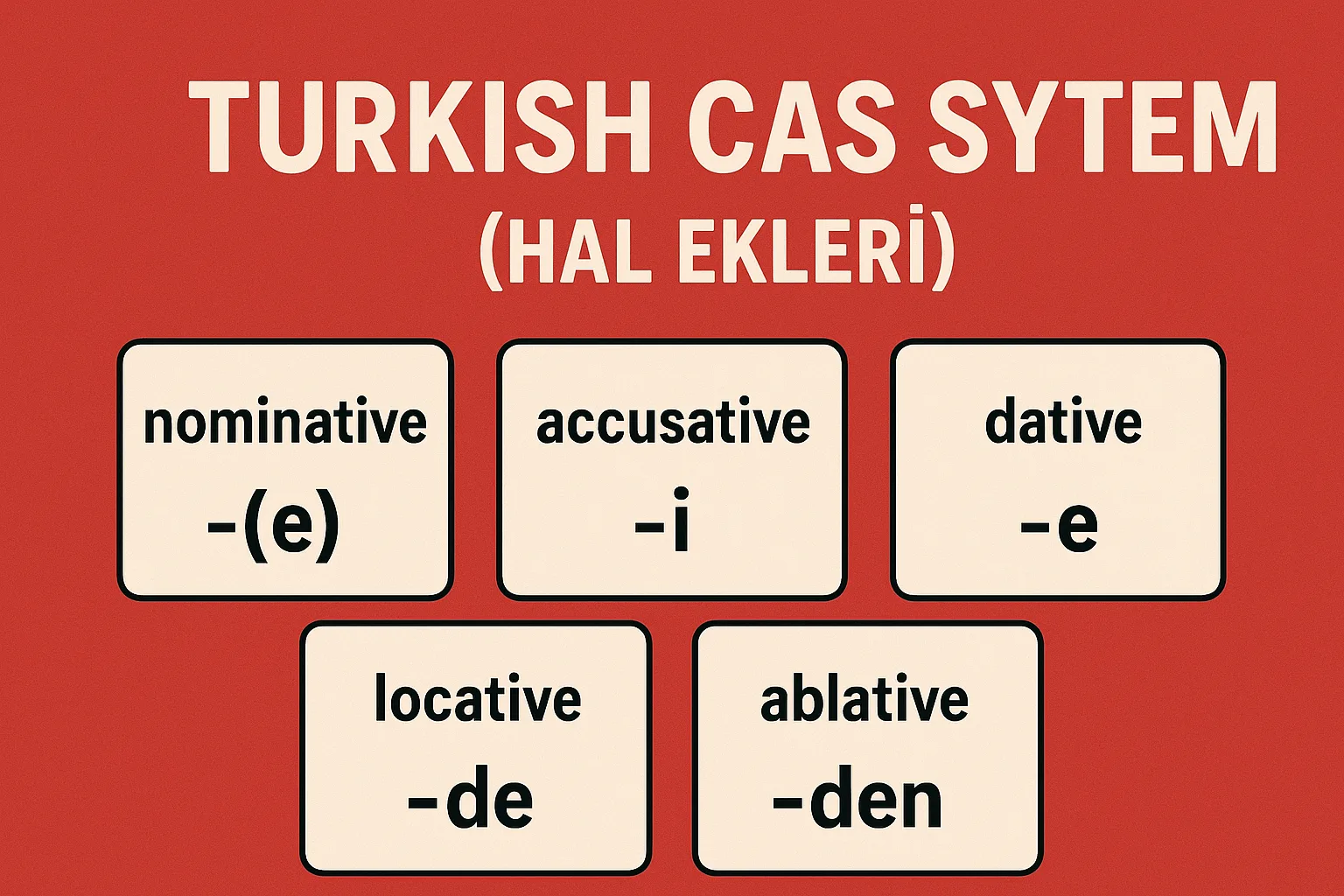
Overview Of The Turkish Case System
Turkish case endings (hâl ekleri) are suffixes attached to nouns, pronouns and some noun phrases to show their grammatical role in the sentence. In modern Turkish, these endings often replace English prepositions such as in, at, to, from, of, with, so understanding them is essential for clear communication.
- Language type: Turkish is an agglutinative language; meaning pieces of meaning are added as stacked suffixes to a word.
- Number of core cases: There are six core noun cases usually taught in standard Turkish: nominative, accusative, dative, locative, ablative and genitive.
- Key concept: Vowel harmony and consonant changes shape the exact form of each suffix.
- Turkish term: These endings are traditionally called “ismin hâl ekleri” or simply “hâl ekleri”.
How Cases Work In Turkish
In Turkish grammar, cases are marked by adding a case suffix after any plural and possessive suffixes. The word order is flexible, but the case endings show who is doing what to whom, where, and in which direction.
- Subject is usually in the nominative (bare form).
- Definite direct object takes the accusative ending.
- Goal or direction is expressed with the dative.
- Location is shown with the locative.
- Source or movement away uses the ablative.
- Possession and relationships are handled by the genitive together with possessive suffixes.
Quick Reference Table For Turkish Cases
The table below gives a compact overview of the main Turkish cases using the word ev (house) as a model.
| Case | Turkish Name | Suffix Pattern* | Typical Meaning | Example |
|---|---|---|---|---|
| Nominative | Yalın hâl | ∅ (no suffix) | subject, bare form | ev – house |
| Accusative | Belirtme hâli | -(y)I → ı / i / u / ü | definite direct object | evi – the house (as object) |
| Dative | Yönelme hâli | -(y)A → a / e | to, towards | eve – to the house |
| Locative | Bulunma hâli | -DA → da / de / ta / te | in, at, on | evde – in the house |
| Ablative | Ayrılma hâli | -DAn → dan / den / tan / ten | from, out of | evden – from the house |
| Genitive | Tamlayan hâli | -(n)In → ın / in / un / ün | of, ’s | evin – of the house |
*Suffix patterns follow vowel harmony and consonant rules explained below. The capital letter (I, A, D, N) stands for sets of possible sounds.
The Six Core Turkish Cases (Ismin Hâl Ekleri)
Nominative Case – Yalın Hâl
- Form: no case suffix: ev, kitap, çocuk.
- Main use: subject of the sentence, indefinite object, dictionary form.
- Question words: kim? (who?), ne? (what?).
Examples with nominative nouns:
- Ev büyük. – The house is big.
- Çocuk oynuyor. – The child is playing.
- Kitap okurum. – I read books / I read a book. (indefinite object)
Accusative Case – Belirtme Hâli (-(y)I)
- Function: marks a definite direct object (“the X”, not “a X”).
- Suffix pattern: -(y)I → -ı, -i, -u, -ü, depending on vowel harmony.
- Buffer consonant: if the noun ends in a vowel, add -y- before the suffix: araba → arabayı.
Key idea: use the accusative when the object is specific or already known.
- Kitap okuyorum. – I am reading a book / I read books.
- Kitabı okuyorum. – I am reading the book.
- Arabayı gördüm. – I saw the car.
Dative Case – Yönelme Hâli (-(y)A)
- Function: shows direction, goal, recipient or purpose – similar to to, towards, for in English.
- Suffix pattern: -(y)A → -a, -e.
- Buffer consonant: nouns ending in a vowel take -y-: okul → okula, oda → odaya.
Typical uses of the dative case:
- Destination: Eve gidiyorum. – I am going home.
- Recipient: Arkadaşıma yazıyorum. – I am writing to my friend.
- Purpose / aim: Çalışmaya geldim. – I came to work.
Locative Case – Bulunma Hâli (-DA)
- Function: indicates place or time where something is or happens; similar to in, on, at.
- Suffix pattern: –DA → -da, -de, -ta, -te (voicing depends on final consonant of the noun).
- Meaning: “at X”, “in X”, “on X”.
Examples of locative case in everyday Turkish:
- Evdeyim. – I am at home.
- Okulda buluşalım. – Let’s meet at school.
- Masada su var. – There is water on the table.
Ablative Case – Ayrılma Hâli (-DAn)
- Function: expresses movement from, out of, because of, among.
- Suffix pattern: –DAn → -dan, -den, -tan, -ten.
- Typical meanings: “from X”, “out of X”, sometimes “than X” in comparisons.
The ablative is extremely common in spoken Turkish:
- Evden geliyorum. – I am coming from home.
- İstanbul’dan döndük. – We returned from Istanbul.
- Senden öğrendim. – I learned (it) from you.
Genitive Case – Tamlayan Hâli (-(n)In)
- Function: marks the possessor or “of” relationship.
- Suffix pattern: -(n)In → -ın, -in, -un, -ün.
- Buffer consonant: after vowels, insert -n- before the suffix: okul → okulun, kedi → kedinin.
In Turkish, the genitive case almost always appears together with a possessive suffix on the possessed noun.
- Ali’nin arabası. – Ali’s car.
- Ev in kapısı. – The door of the house.
- Öğrencilerin kitapları. – The students’ books.
Instrumental / Comitative With -(y)le / -(y)la
Many grammars also mention a “with” ending written as -le / -la, often attached as -(y)le / -(y)la. It behaves like a case in everyday language, even though it historically comes from the postposition ile.
- Instrument: Kalemle yazıyorum. – I am writing with a pen.
- Company: Arkadaşımla geldim. – I came with my friend.
- Vowel-final noun: araba → arabayla (with the car).
Vowel Harmony In Case Suffixes
Case endings in Turkish obey vowel harmony, which keeps words smooth and easy to pronounce. Learners who understand this system can predict the correct form of most case suffixes without memorising long lists.
- A-type suffixes (-(y)A): use -a after back vowels (a, ı, o, u) and -e after front vowels (e, i, ö, ü).
oda → odaya, şehir → şehre - I-type suffixes (-(y)I, -(n)In): four-way harmony:
- Back & unrounded: -ı (a, ı)
- Front & unrounded: -i (e, i)
- Back & rounded: -u (o, u)
- Front & rounded: -ü (ö, ü)
- DA / DAn suffixes: vowels follow the same front/back rule; consonants alternate d ~ t for voicing:
- ev → evde / evden
- okul → okulda / okuldan
- ağaç → ağaçta / ağaçtan
Buffer Consonants: -y- And -n-
When a noun already ends in a vowel, Turkish avoids having two vowels directly together. To keep pronunciation clear, it adds buffer consonants between the stem and the suffix.
- -y- buffer: appears before A-type and I-type case endings and with -(y)le:
- araba → arabayı, arabaya, arabayla
- anne → anneyi, anneye
- -n- buffer: appears when a third-person possessive ending is followed by a case ending:
- ev+i (his/her house) → evini, evine, evinden
- araba+sı (his/her car) → arabasını, arabasına
Once you notice these patterns with -y- and -n-, many complex-looking forms become easy to parse and even easy to writen correctly.
Order Of Suffixes On Nouns
Turkish allows several suffixes in a row. The usual order for nouns is:
- Root → plural → possessive → case
Example with evlerimizden (“from our houses”):
- ev – house (root)
- evler – houses (plural suffix -ler)
- evlerimiz – our houses (1st person plural possessive -imiz)
- evlerimizden – from our houses (ablative -den)
Case Usage Patterns To Notice
For learners, it helps to link each case ending to common questions and prepositions. This makes the system more intuitive and keeps your focus on meaning, not just forms.
- Nominative (∅): answers who? what?
- Accusative (-(y)I): answers whom? what (specifically)?
- Dative (-(y)A): answers to where? to whom? for what?
- Locative (-DA): answers where? at what time?
- Ablative (-DAn): answers from where? because of what?
- Genitive (-(n)In): answers whose? of what?
Sample Sentences With Multiple Cases
These examples show how different Turkish cases work together in a natural sentence. Focus on the endings marked in bold and the English meaning.
- Öğretmen öğrencilere kitabı verdi.
The teacher gave the book to the students.
(öğretmen – nominative, öğrencilere – dative, kitabı – accusative) - Arkadaşımın evinde akşam yemeği yedik.
We ate dinner at my friend’s house.
(arkadaşımın – genitive, evinde – locative) - İstasyondan şehre otobüsle gidiyoruz.
We go from the station to the city by bus.
(istasyondan – ablative, şehire – dative, otobüsle – “with/by”) - Çocukların bahçede oyun oynadığını gördüm.
I saw that the children were playing in the garden.
(çocukların – genitive, bahçede – locative)
Checklist For Practising Turkish Cases
When you build sentences, use this short practice checklist to stay consistent and accurate.
- Identify roles: ask yourself who is doing the action? (subject), what or whom? (object), where?, from where?, to where?.
- Decide definiteness: if the object is specific, use the accusative; if it is general, leave it in the nominative.
- Apply vowel harmony: choose -a/-e or -ı/-i/-u/-ü based on the last vowel of the stem.
- Check buffers: add -y- or -n- when two vowels would meet or when a possessive suffix comes before a case.
- Compare with English: think which preposition you would use in English (in, at, to, from, of, with) and match it with the closest Turkish case.
- Repeat common patterns: practise short, high-frequency structures like evdeyim, işe gidiyorum, senden geldim.
Sources
- Turkish Grammar – Case Section, detailed overview of Turkish noun cases and endings: https://en.wikipedia.org/wiki/Turkish_grammar#Case
- Turkish / Cases – Wikibooks, open grammar notes on Turkish case usage with examples: https://en.wikibooks.org/wiki/Turkish/Cases
- Case Feature For Turkish – Universal Dependencies, technical description of case marking in Turkish corpora: https://universaldependencies.org/tr/feat/Case.html
- An Analysis Of The Accusative Case Use Of Learners Of Turkish As A Foreign Language, Journal of Mother Tongue Education (Ondokuz Mayıs University): https://dergipark.org.tr/tr/download/article-file/515197