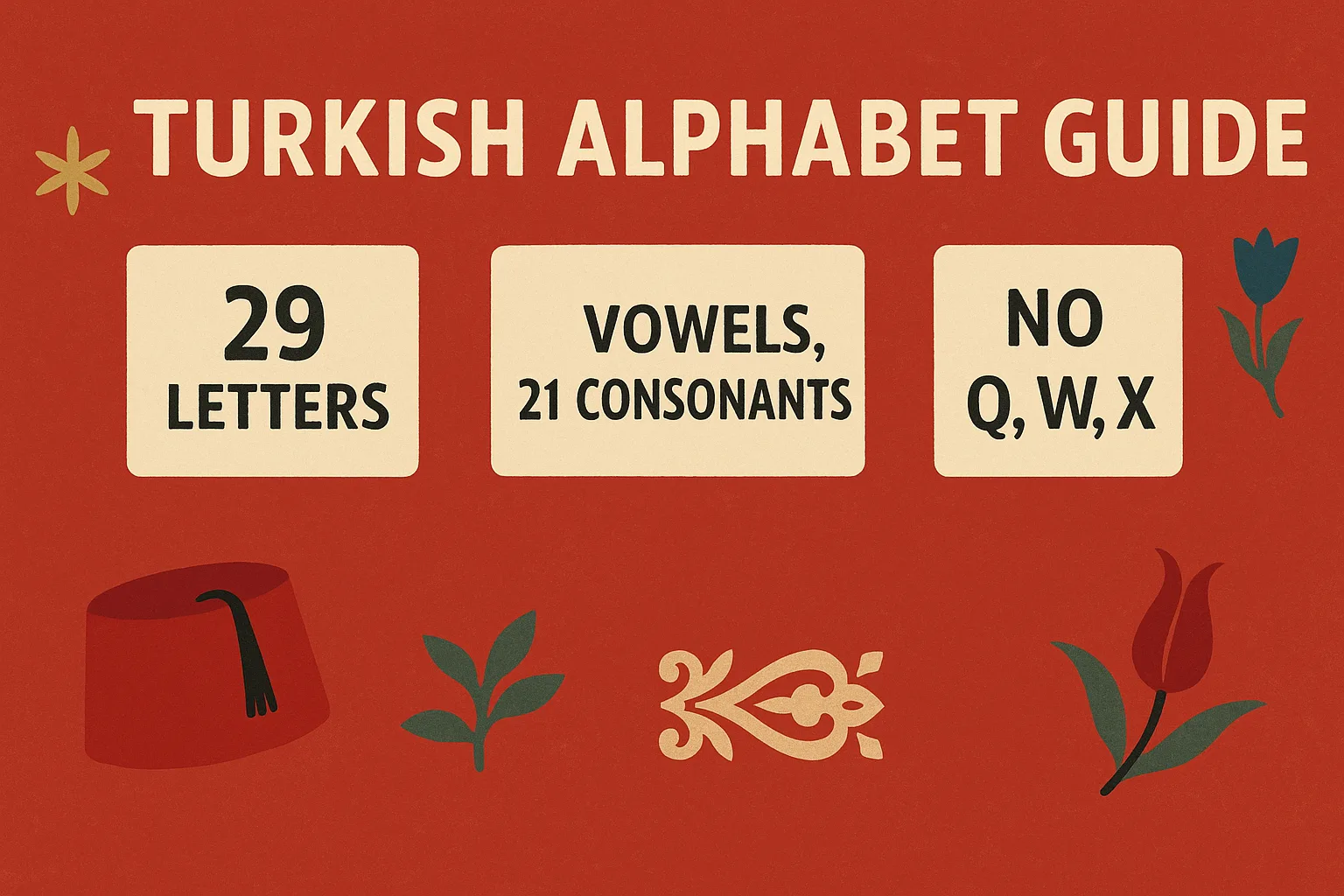
The modern Turkish alphabet is a Latin-based writing system with 29 letters, carefully designed so that almost every sound in Turkish matches a single letter. This gives the language a very regular spelling system and makes pronunciation much more predictable than in many other languages. For anyone who wants to read street signs, follow Turkish news or study in Türkiye, learning this alphabet is the natural starting point.
Key Facts About The Turkish Alphabet
- A B C Ç D E F G Ğ H I İ J K L M N O Ö P R S Ş T U Ü V Y Z
- Alphabet Type: A Latin script with 29 official letters.
- Vowels: 8 vowels – A, E, I, İ, O, Ö, U, Ü.
- Consonants: 21 consonants, including the distinctive letters Ç, Ğ, Ş.
- Special Characters: Seven letters use diacritics – Ç, Ğ, I, İ, Ö, Ş, Ü – and each has its own sound.
- Missing Letters: The letters Q, W, X are not part of the official alphabet; they appear only in some foreign names and brands.
- Spelling Principle: One letter, one main sound – Turkish is strongly phonetic, so words are written as they are pronounced.
Structure Of The Turkish Alphabet
The Turkish alphabet consists of letters that are already familiar to users of the Latin script, plus a small set of modified characters. Together they form a system where spelling and sound match closely, which is especially helpful for new learners.
- Total letters: 29.
- Vowels (8): A, E, I, İ, O, Ö, U, Ü.
- Consonants (21): B, C, Ç, D, F, G, Ğ, H, J, K, L, M, N, P, R, S, Ş, T, V, Y, Z.
- Alphabet order: Largely follows the Latin order, but includes Ç, Ğ, I, İ, Ö, Ş, Ü in fixed places (for example, Ç comes after C, and Ş after S).
Vowels In The Turkish Alphabet
Turkish has eight vowel letters, grouped into front/back and rounded/unrounded vowels. This structure supports vowel harmony, a central feature of Turkish word formation and suffixes.
| Letter | Name (Turkish) | Approximate Sound (English) |
|---|---|---|
| A a | a | Like a in father |
| E e | e | Like e in red |
| I ı | ı | A central sound, similar to the last vowel in about when said quickly |
| İ i | i | Like ee in see |
| O o | o | Similar to o in more |
| Ö ö | ö | Front rounded vowel; close to German ö in schön |
| U u | u | Like oo in food |
| Ü ü | ü | Front rounded vowel; similar to French u in tu |
For Turkish vowels, the spelling is stable: each letter normally keeps the same sound in every word. This consistency is a major advantage for pronunciation and supports rapid reading once the basic sounds are familiar.
Consonant Letters In Turkish
There are 21 consonant letters in the Turkish alphabet. Many are close to their English counterparts, but some have different values that learners should notice from the beginning.
- C c is pronounced like j in “job”, not like English c in “cat”.
- Ç ç corresponds to “ch” as in “chair”.
- Ş ş sounds like “sh” in “shoe”.
- J j is used mainly in loanwords and is similar to the s sound in English “measure”.
- G g and K k can be slightly softer or harder depending on the surrounding vowels, but their basic sound remains stable.
Unique Turkish Letters You Should Recognise
Some letters in the Turkish alphabet do not exist in standard English. Understanding them early prevents common reading and writing mistakes.
- Ç ç – Always pronounced like “ch” in “chair”. Example: çay (tea).
- Ş ş – Always like “sh” in “she”. Example: şeker (sugar).
- Ö ö – A front rounded vowel; lips are rounded, tongue is forward. Similar to German ö. Example: göl (lake).
- Ü ü – Another front rounded vowel; close to French u in tu. Example: gün (day).
- I ı and İ i – Two separate letters. I ı is dotless and represents a central vowel; İ i is dotted and sounds like English “ee”.
- Ğ ğ (“yumuşak g” – soft g)
The letter Ğ ğ is particularly special. It never appears at the beginning of a word. Instead of having a strong sound of its own, it often lengthens the preceding vowel or creates a smooth connection between vowels, as in dağ (mountain) or ağız (mouth).
Dotted And Dotless “I”
One of the most characteristic features of Turkish spelling is the distinction between dotted and dotless I. These four forms behave as separate letters in the alphabet:
- İ – uppercase dotted I
- i – lowercase dotted i
- I – uppercase dotless I
- ı – lowercase dotless ı
In capitalisation, this means that i → İ and ı → I, which is different from English. Software that ignores this rule can produce confusing results, so paying attention to the dots is important both in handwriting and in digital text.
Optional Accent Marks: Â, Î, Û
In some words of Arabic or Persian origin, Turkish may use the circumflex accent on vowels: â, î, û. These marks are not separate letters of the alphabet but can show vowel length or a slightly different quality of the preceding consonant, as in kâr (profit) versus kar (snow).
In everyday writing, many native speakers omit these accents, but in formal texts and dictionaries they still help to avoid ambiguity and to preserve accurate pronunciation.
Spelling Rules And Pronunciation Tips
The spelling system of Turkish is highly regular. Once the basic sounds of each letter are known, it becomes possible to read new words confidently, even without having seen them before.
- One main sound per letter: Turkish avoids multiple unrelated sounds for the same letter. This makes reading aloud straightforward.
- No silent letters: Unlike English, almost every letter is pronounced. The “soft g” (ğ) behaves differently, but it still affects the sound of the word.
- Stress pattern: In many words, the last syllable carries the main stress. There are exceptions (especially place names and some loanwords), but this rule is a helpful guide.
- Loanwords: Foreign words are often adapted to match Turkish phonetic rules, so their spelling usually fits the sound system of the alphabet.
Alphabet Reform And Modern Use
The Latin-based Turkish alphabet was officially adopted in 1928 as part of a broader language reform. It replaced the Ottoman script and was designed to match the sound structure of Turkish much more closely.
- Clear sound–letter match: The reform focused on choosing letters that represent existing Turkish sounds directly.
- Education and literacy: A simpler, phonetic alphabet supported the rapid expansion of basic education and easier access to print materials.
- Continuity today: The same 29-letter alphabet is used in schools, official documents, media and digital communication, giving a stable basis for reading and writing.
Practical Ways To Practise The Turkish Alphabet
Because the system is consistent and phonetic, even short, regular practice brings quick results. Below are simple activities that help you internalise the letters and sounds.
- Read aloud every day: Take short word lists or children’s books in Turkish and sound out each word carefully, focusing on special letters like Ç, Ş, Ö, Ü, Ğ.
- Write and say: Choose 5–10 new words, write them by hand, and pronounce them slowly. Combining writing and speaking fixes the letters in memory for many learnres.
- Sort by vowels: Group words by their main vowel (for example, all words with ö in one list). This supports your understanding of vowel harmony and sound patterns.
- Focus on pairs: Practise minimal pairs such as kar / kâr, gül / göl, şu / şuğ (in phrases) to feel how vowel quality and ğ change the sound.
- Use real-life text: Street names, product labels and official websites in Turkish provide authentic examples of how the alphabet appears in everyday life.