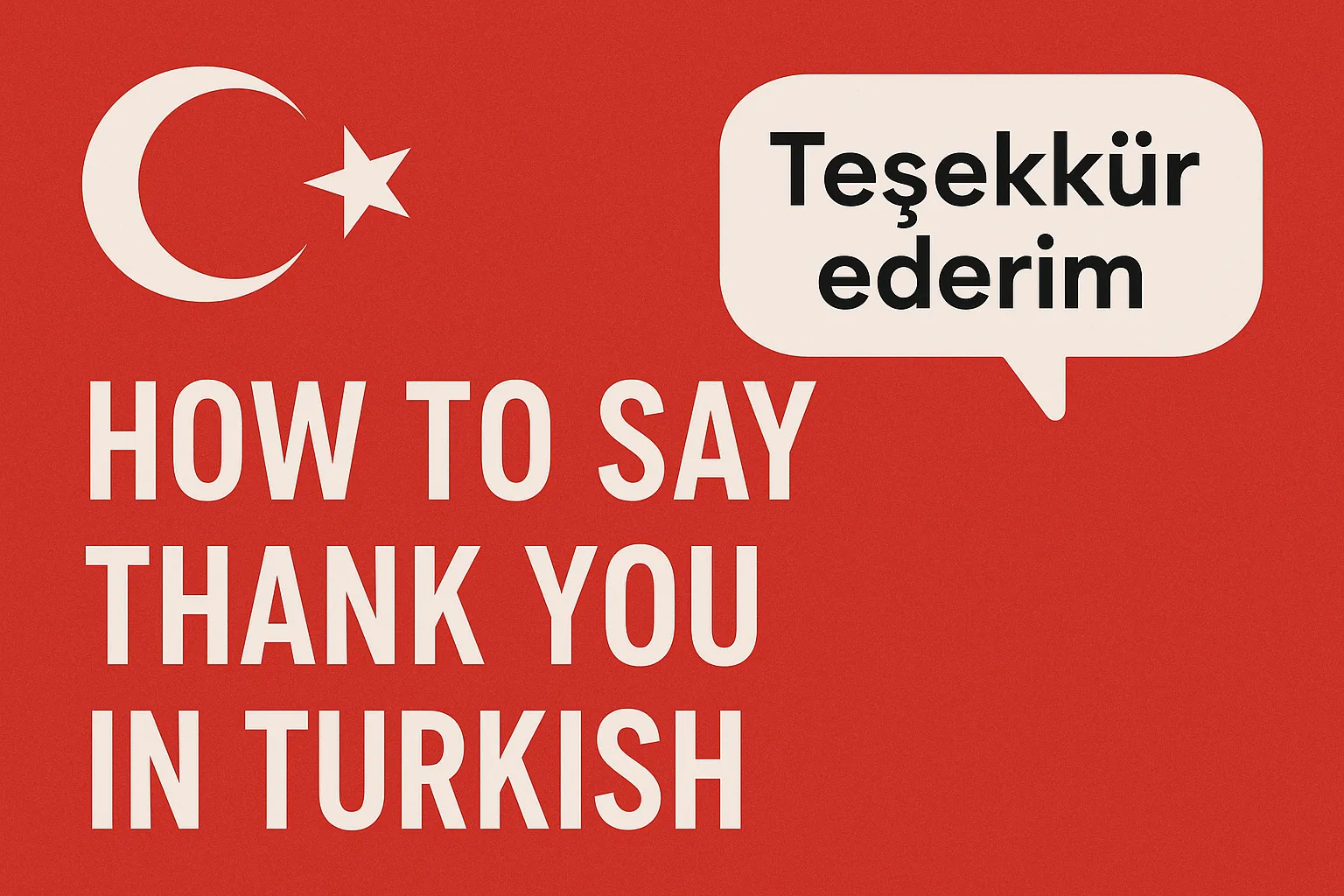
Turkish thank-you phrases are short, clear, and easy to reuse. This guide focuses on real-life wording, formality, and pronunciation you can trust in everyday settings.
The most standard way to say “thank you” in Turkish is teşekkür ederim. It works in almost any polite situation, from a shop to a workplace. Turkish is written in a Latin-based alphabet, so once you learn a few letters like ş and ü, these phrases become very predictable.
Core Thank-You Phrases
- Teşekkür ederim — the default “thank you,” polite and widely safe.
- Çok teşekkür ederim — “thank you very much,” adds warmth without sounding dramatic.
- Teşekkürler — “thanks,” slightly more casual, commom in quick exchanges.
- Sağ ol — informal “thanks,” literally “be well,” used with friends or peers.
- Sağ olun — more respectful “thanks,” often used to elders, customers, or strangers.
- Ellerinize sağlık — “health to your hands,” a classic thank-you for food or skilled work.
Meaning and Formality
Teşekkür ederim comes from teşekkür (thanks) + ederim (“I do / I make”), so the sense is “I give thanks.” Think of it as a formal handshake in word form: simple, steady, and appropriate in many places.
| Phrase | Best Use | Formality | Quick Pronunciation Cue |
|---|---|---|---|
| Teşekkür ederim | General thanks (shops, offices, daily life) | Polite | teh-SHEK-kur eh-deh-RIM |
| Çok teşekkür ederim | Extra appreciation (help, kindness) | Polite+ | chok + teh-SHEK-kur eh-deh-RIM |
| Teşekkürler | Quick “thanks” (short replies) | Neutral | teh-SHEK-kur-ler |
| Sağ ol | Friends, casual support | Casual | sah-OL |
| Sağ olun | Respectful thanks (elders, service) | Respectful | sah-OO-loon |
| Ellerinize sağlık | Food or craft | Polite | el-leh-ri-NEE-zeh sah-lik |
Pronunciation Notes That Matter
- ş sounds like “sh” in “ship”: teşekkür.
- ü is a rounded front vowel, like French “u” in “lune.” It’s the key sound in teşekkür.
- ğ often softens or lengthens the vowel around it. It usually is not a hard “g.”
- ı (dotless i) sounds like a short, relaxed vowel (not “ee”). It appears in many everyday words, so it helps to recognize it early.
For teşekkür ederim, a practical split is te-şek-kür + e-de-rim. Keep your pace steady; Turkish pronunciation is often more consistent than English spelling.
Choosing the Right Tone
- Formal settings: use teşekkür ederim or çok teşekkür ederim.
- Fast, everyday moments: teşekkürler works well when you are in a hurry.
- Close friends: sağ ol feels natural and friendly.
- Respectful casual: sağ olun keeps it warm while showing distance.
In Turkish, tone does a lot of work. A calm voice and a small nod can make teşekkür ederim feel genuinely personal even when the words are short.
Short words, clear meaning: Turkish gratitude often feels like a small key that opens a friendly moment.
How to Reply When Someone Thanks You
If someone says teşekkür ederim to you, these replies sound natural. Choose one that matches the setting and your relationship.
- Rica ederim — “you’re welcome,” polite and reliable in most situations.
- Bir şey değil — “it’s nothing,” friendly and casual.
- Ne demek — “what do you mean,” used like “no problem.”
- Estağfurullah — humble, traditional, often used to downplay praise.
Rica ederim is the safest default. It fits business talk, service settings, and polite everyday speech without sounding stiff.
Mini Dialogues You Can Reuse
These short scripts are designed for copy-and-say practice. Read them aloud twice, then swap the situation words.
In a shop
A: Buyurun. (Here you go.)
B: Teşekkür ederim. (Thank you.)
A: Rica ederim. (You're welcome.)

With a friend
A: Yardım edeyim mi? (Want me to help?)
B: Evet, lütfen. (Yes, please.)
A: Tamam. (Okay.)
B: Sağ ol! (Thanks!)
A: Ne demek! (No problem!)
If you want to sound more formal, replace sağ ol with sağ olun and keep the rest the same. That one change can shift the whole feel.
Small Details That Make You Sound Natural
- Use Turkish characters when you can: teşekkür is clearer than tesekkur.
- Match the relationship: sağ ol for close, sağ olun for respectful distance.
- Add “çok” only when it fits: çok teşekkür ederim is perfect after real help, not needed for tiny favors.
- Learn one special phrase: ellerinize sağlık is memorable and often appreciated.
Quick Practice Plan
- Say teşekkür ederim ten times, slowly, focusing on ş and ü.
- Switch to speed: say teşekkürler five times as a quick reply.
- Role-play one real moment (taxi, café, office) and answer with rica ederim.
Sources
- Turkish Language Association (TDK) Dictionaries Portal
- Northwestern University: The Turkish Alphabet
- University of Texas at Austin: Turkish Vowel Harmony Module
- The Ohio State University: Turkish Sounds (IPA) PDF
- UCLA: Words of Gratitude (Includes Turkish Examples)
- Yunus Emre Institute: Turkish Dialogue Example With “Teşekkür ederiz”