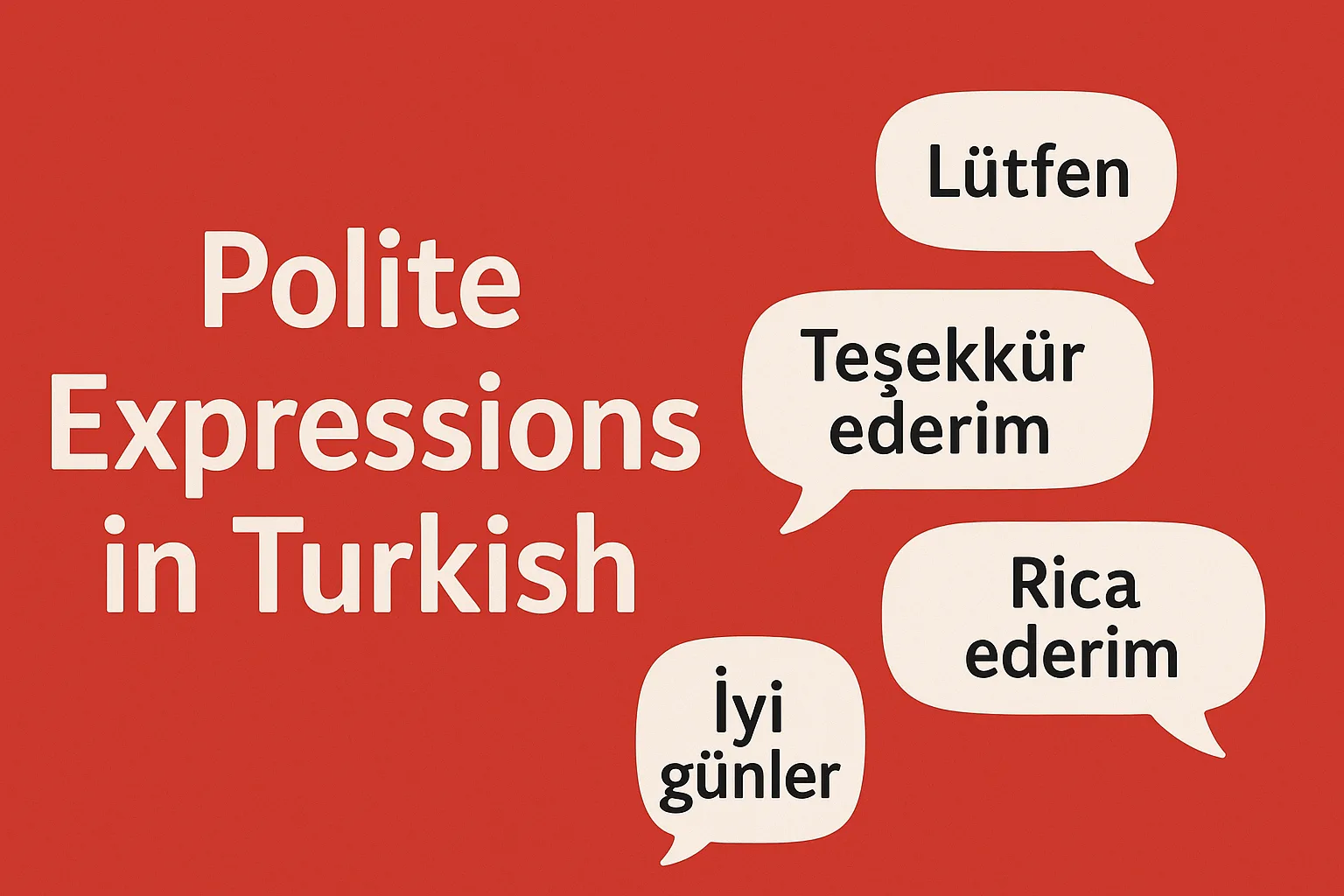
Polite Turkish is not a “bonus skill.” It is the default setting of everyday interaction, especially with new people. A few well-chosen polite expressions in Turkish can make your speech feel calm, respectful, and natural—like a door that opens smoothly instead of sticking.
Quick Start: Polite Expressions You Can Use Today
- Lütfen (please) — a direct “please,” best when paired with a clear request.
- Teşekkür ederim (thank you) — neutral, safe, widely used.
- Sağ olun (thank you / be well) — slightly more formal, warm tone.
- Rica ederim (you’re welcome / please) — also appears inside polite requests.
- Buyurun (here you go / please go ahead) — common in service settings.
- Affedersiniz (excuse me) — for attention, passing by, or a gentle interruption.
- Pardon (sorry / pardon) — quick, casual, often used with strangers.
- Kusura bakmayın (sorry for the trouble) — polite apology, good for small mistakes.
- Özür dilerim (I apologize) — stronger than pardon.
- Memnun oldum (nice to meet you) — formal-ish and very common.
- Hoş geldiniz (welcome) — used to greet someone who arrived.
- Hoş bulduk (glad to be here) — the expected reply to hoş geldiniz.
Key Phrases Overview
Polite expressions in Turkish often work in pairs: one person offers, the other responds. That rhythm matters. It is like a handshake made of words—simple, expected, and reassuring.
| Expression | Closest Meaning | When to Use | Tone |
|---|---|---|---|
| Lütfen | Please | Requests, reminders | Neutral–polite |
| Teşekkür ederim | Thank you | Gratitude, appreciation | Neutral |
| Rica ederim | You’re welcome / please | Reply to thanks, polite asking | Polite |
| Buyurun | Here you go / go ahead | Offering, inviting, serving | Helpful |
| Affedersiniz | Excuse me | Getting attention, passing by | Formal–neutral |
| Kusura bakmayın | Sorry for the inconvenience | Small errors, interruptions | Soft |
| Memnun oldum | Pleased to meet you | Introductions | Polite |
| Hoş geldiniz / Hoş bulduk | Welcome / glad to be here | Arrivals (home, office, shop) | Warm |
A single polite phrase can do more than perfect grammar. It signals good intentions, and that matters.
Formality: Sen, Siz, and Everyday Titles
Sen vs Siz
- Sen (you, informal) — friends, close peers, family, children.
- Siz (you, formal or plural) — strangers, older people, customers, professionals, first meetings.
If unsure, start with siz. It is easier to shift from formal to informal than the other way around. It is worth remebering that many polite requests sound more natural with -misiniz endings.
Useful Titles
- Bey / Hanım — polite address after a first name: Ahmet Bey, Elif Hanım.
- Hocam — “my teacher,” also used for lecturers, instructors, and sometimes professionals (respectful, common).
- Efendim — “yes?” / “pardon?” as a polite response when someone calls you, also used to soften speech.
- Abi / Abla — “older brother/sister,” friendly respect in casual settings.
Polite Requests That Sound Natural
Turkish often prefers question-shaped requests. They feel softer than commands. Think of them as a verbal “please step this way,” not a push—more guiding than forcing.
- … alabilir miyim? (May I get…?)
Example: Bir su alabilir miyim? (May I get a water?) - … yapabilir misiniz? (Could you…?)
Example: Tekrar eder misiniz? (Could you repeat it?) - Rica etsem…? (If I may ask…)
Example: Rica etsem kapıyı açar mısınız? (Would you open the door?) - Zahmet olmazsa… (If it’s not too much trouble…)
Example: Zahmet olmazsa biraz yavaş konuşur musunuz? (Could you speak a bit slower?) - Acaba…? (I wonder if…) — a small word that adds big politeness.
Lütfen also works well with directions and simple requests. Still, in many everyday situations, a question form can feel smoother than adding “please” to an order.
Mini Dialogues You Can Copy
A: Affedersiniz, bakar mısınız?
B: Tabii, buyurun.
A: Bir soru sorabilir miyim?
B: Elbette.
A: Teşekkür ederim.
B: Rica ederim.
A: Kusura bakmayın, geç kaldım.
B: Sorun değil.
Polite Turkish in Real Situations
Shops and Services
- Kolay gelsin (may it be easy) — said to someone working (cashier, clerk, staff).
- Buyurun (go ahead) — you will hear it; you can also use it when handing something.
- Bakar mısınız? (could you help?) — polite attention-getter.
- Teşekkürler (thanks) — shorter and casual than teşekkür ederim.
Food and Hospitality
- Ellerinize sağlık (health to your hands) — a warm compliment after a meal, especially home-cooked.
- Afiyet olsun (enjoy your meal) — said before or during eating.
- Hoş geldiniz (welcome) — staff may greet you with this; reply Hoş bulduk.
- Bir çay alabilir miyim? (May I have a tea?) — classic polite order pattern.
Small Words That Add Respect
- Lütfen — clear politeness marker, best with a calm tone.
- Acaba — makes a request feel less direct: Acaba mümkün mü?
- Biraz — “a bit” softens language: Biraz yavaş…
- Mümkünse — “if possible,” a polite cushion.
- Şey… — a natural hesitation sound (use lightly), often helps speech feel human.
Tip: In Turkish, softening is a skill. A request can stay clear while sounding gentle.
Common Slip-Ups and Cleaner Alternatives
| What Learners Say | Why It Feels Off | Try This |
|---|---|---|
| Sen with a stranger | Too familiar in many first-meeting contexts | Siz + polite verb ending |
| Only saying lütfen as a full sentence | Sounds incomplete without a request | Lütfen + request: Lütfen bekleyin |
| Pardon for serious apologies | Can be too light for bigger mistakes | Özür dilerim or Kusura bakmayın |
| Overusing efendim in every line | It is useful, but can feel theatrical if forced | Use it for replies and attention, not as filler |
Fast Answers to Practical Questions
Is “lütfen” always required?
Not always. Many everyday requests sound more natural as a question, like … alabilir miyim?. Add lütfen when you want extra clarity or emphasis.
When should “hoş geldiniz” be answered?
When someone says Hoş geldiniz, the standard reply is Hoş bulduk. It is a small exchange that signals shared courtesy.
What is the safest “excuse me”?
Affedersiniz is widely safe for attention, passing by, or gentle interruption. Pardon is shorter and more casual.
How can a request sound polite without being long?
Use one softener and a clear verb: Acaba… mümkün mü? or Rica etsem…?. Short, calm, effective.
Sources
- LangMedia (Five College Center for World Languages) – Turkish Useful Expressions
- Arizona State University – Note discussing sen vs siz as a formality choice
- Sabancı University – Guidance on address forms (e.g., hoca, Bey/Hanım)
- Turkish Language Association (TDK) Dictionary – Entry for merhaba
- Turkish Language Association (TDK) Dictionary – Entry for lütfen
- Yunus Emre Institute – Information about the Turkish Teaching Portal