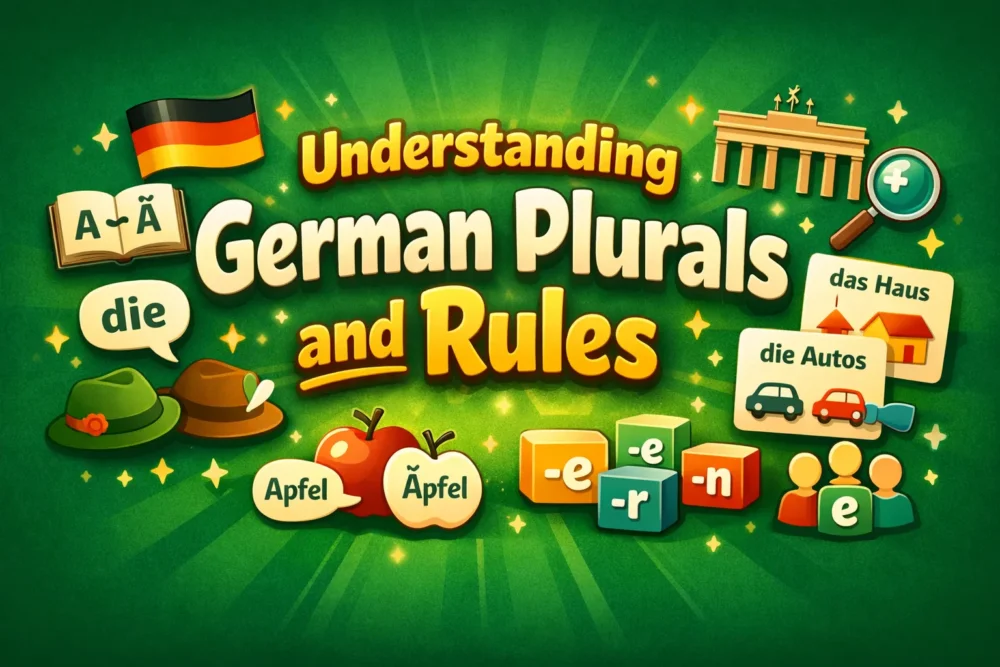
German plurals look simple at first, then you notice the endings. The good news is that there are repeatable plural patterns, and once you spot them, your reading and speaking becomes noticeably smoother. Think of each plural ending as a small label German attaches to nouns to show “more than one.”
What Changes When A Noun Becomes Plural
- The ending may change (like -e, -(e)n, -er, -s).
- The noun may add an umlaut (a vowel shift like a → ä, o → ö, u → ü).
- Some nouns do both, and some do almost nothing.
- Articles simplify: the definite plural is always die in the nominative (no matter the gender in singular).
Common Plural Endings You Will Meet Often
If German plurals feel unpredictable, it helps to treat them like families. Each family has a usual ending, plus a few common “signature moves” like an umlaut.
- -(e)n is extremely frequent, especially for many feminine nouns (often those ending in -e).
- -e appears often with masculine and neuter nouns, sometimes with an umlaut.
- -er is common with some neuter nouns, and umlaut is a regular partner in that group.
- -s is typical for many loanwords, abbreviations, and some modern nouns.
- Zero plural (no ending change) shows up in several predictable clusters.
A practical habit: learn each noun with its plural form, the same way you learn a phone number with its area code. It saves real time later.
| Plural Pattern | Example | What To Notice |
|---|---|---|
| -(e)n | die Blume → die Blumen | Very common with many feminines (esp. -e). |
| -e | der Hund → die Hunde | Often masculine/neuter; plain ending. |
| -e + umlaut | die Kuh → die Kühe | Umlaut can tag along with -e. |
| -er | das Kind → die Kinder | Common for some neuter nouns. |
| -er + umlaut | der Mann → die Männer | Classic pattern: both changes at once. |
| -s | das Auto → die Autos | Frequent with loans/short forms. |
| Zero plural | das Fenster → die Fenster | Same form; common in several groups. |
| Umlaut only | der Vater → die Väter | Meaning changes, ending stays “quiet.” |
Small but useful detail: plural nouns usually keep the same capitalization, and plural articles help your eyes “lock on” to the noun quickly when reading.
Helpful Tendencies When Guessing A Plural
German plural formation has patterns, yet it is not a single clean formula. Still, a few high-payoff tendencies reduce guessing. Treat them like road signs: they won’t guarantee the route, but they stop you from driving blind.
Nouns That Often Take -(e)n
- Many feminine nouns ending in -e: die Straße → die Straßen.
- Many nouns ending in -ung, -heit, -keit, -schaft: die Wohnung → die Wohnungen.
- Female person nouns ending in -in often take -nen: die Studentin → die Studentinnen.
Nouns That Often Take -s
- Many loanwords and international words: das Hotel → die Hotels.
- Short forms and abbreviations: der LKW → die LKWs.
- Some nouns ending in a vowel: das Sofa → die Sofas.
Umlaut Changes You Should Recognize
An umlaut is a written cue that the vowel sound shifts. In plurals, it is most often seen with a, o, u (and sometimes au). It can appear with endings, or it can stand alone.
- a → ä: der Mann → die Männer; die Hand → die Hände.
- o → ö: das Wort → die Wörter.
- u → ü: die Kuh → die Kühe.
- au → äu: das Haus → die Häuser.
Reading tip: when you see ä/ö/ü/äu in a plural, your brain can treat it like a neon sign that says “plural nearby.” That one signal improves comprehension fast.
Zero Plurals And Predictable Groups
Not every plural needs an extra ending. Some nouns keep the same form, which can feel surprising until you learn the usual clusters. This is one of the calmer areas of German plural rules, honestly.
- Diminutives ending in -chen or -lein often stay the same: das Mädchen → die Mädchen.
- Many nouns ending in -el, -en, -er are frequently zero plural: der Lehrer → die Lehrer; das Fenster → die Fenster.
- Some family terms and older core vocabulary may show umlaut-only plurals: der Vater → die Väter.
Plural Articles And Determiners
Plural articles are a relief. In the nominative, the definite plural is always die. There is no true plural form of ein, so German typically uses a determiner like keine or a possessive like meine.
Clear Examples
- die Bücher sind neu. (definite plural)
- Ich habe keine Bücher. (negative plural)
- meine Bücher sind hier. (possessive plural)
Adjectives follow the plural determiner and use familiar endings. What matters for plural comfort is recognizing the plural noun form quickly, not memorizing every chart at once.
Fast Reading Shortcut
When you see die plus a noun ending like -en or -er, assume plural unless context clearly says otherwise. This simple cue can speed up comprehension in real texts.
The Dative Plural -n Rule
German adds a small extra signal in one common place: the dative plural. If a plural noun does not already end in -n or -s, it usually adds -n. Learners often forget this, then later wonder why a sentence “sounds off.”
| Plural Base | Dative Plural Form | Example |
|---|---|---|
| die Kinder | den Kindern | Ich helfe den Kindern. |
| die Blumen | den Blumen | Mit den Blumen wirkt es frischer. |
| die Autos | den Autos | Bei den Autos bleibt es meist gleich. |
This is a small rule with big impact, and it is easier to recieve in context than from a chart alone.
Plurals Inside Compound Nouns
German compounds usually pluralize the final noun, not every part. This keeps the structure tidy and readable.
- das Kinderbuch → die Kinderbücher (plural on the last element, with a visible umlaut)
- die Haustür → die Haustüren (plural with -en at the end)
- der Sprachkurs → die Sprachkurse (plural with -e)
Why it matters: if you can spot the head noun, you can usually spot the plural marker. That skill pays off in long words.
Learning Habits That Make Plurals Stick
German plurals become manageable when they are learned as part of each noun, not as a separate topic. The goal is automatic recall, not perfect theory.
- Write vocabulary as article + singular + plural: der Mann, die Männer.
- Group nouns by plural family (all your -(e)n words together, etc.).
- Say the plural out loud once when you learn it. Sound memory is a real tool.
- Use short sentences you can reuse: Ich sehe…, Ich brauche…, Ich habe…
A Compact Practice Set
Fill in the plural, then read the pair aloud. Aim for steady accuracy, not speed.
- das Buch → die ______
- die Stadt → die ______
- der Apfel → die ______
- das Kind → die ______
- das Haus → die ______
Show Sample Answers
die Bücher, die Städte, die Äpfel, die Kinder, die Häuser
FAQ
Why does German have several plural endings?
German nouns come from different historical patterns, and modern usage preserves multiple plural families. For learners, it helps to focus on the most frequent endings first.
Is there one rule that always works for plurals?
There is no single rule that covers every noun, but there are strong tendencies (like many feminine nouns taking -(e)n). The most reliable approach is learning the plural with the noun.
When do I add an umlaut in the plural?
Umlaut changes are common with certain core nouns and patterns (like Mann → Männer or Haus → Häuser). Because it depends on the noun, it is best treated as part of the stored plural form.
What is the dative plural -n and why do people add it?
In dative plural, German often adds -n to the noun if it does not already end in -n or -s. It is a small marker that supports clarity in sentences like mit den Kindern.
Do articles change in the plural?
Yes, and this is a relief: the nominative definite plural article is always die. For “a/an” in plural, German typically uses other determiners such as keine or meine.
References
- University of Texas at Austin (COERLL) – Grimm Grammar: Nouns (Plural)
- Case Western Reserve University – Endings of German Nouns (Comparative Table)
- University of Michigan – Grammar Resources (Case Overviews and Plural Notes)
- Miami University – Determinants of Gender in German (Plural Clues and Patterns)
- Portland State University – Reference Grammar (PDF)